Pet toy designers often face a critical material decision: how soft or hard should the toy be? As a silicone manufacturing factory, we know that getting the Shore hardness right is key to a toy’s success. The hardness of a silicone or natural rubber toy affects its durability, flexibility, and, most importantly, pet safety. In this post, we’ll demystify Shore hardness (including the Shore A and Shore 00 scales) and explore how different hardness levels suit various pet types – from gentle puppies and cats to power-chewing dogs. We’ll also share insights on selecting the optimal material hardness for different pet toy styles (chew toys, fetch toys, treat-dispensers) and discuss how manufacturers test and ensure quality. By the end, you’ll see why collaborating with your material supplier on hardness selection can make all the difference in creating safe, enjoyable pet toys.

What Is Shore Hardness?

Shore hardness measures a material’s resistance to indentation – essentially how “hard” or “soft” it is. The measurement is done with a spring-loaded device called a durometer, which presses a standardized needle into the material’s surface. The depth of indentation is converted to a hardness value on a scale of 0 to 100, where higher numbers mean a harder material. A reading of 0 would indicate an extremely soft gel, while 100 would be as hard as a solid plastic or glass. In practice, most rubbery materials fall somewhere in between.

Shore Hardness Scales (A and 00): There are several Shore scales for different material types. The two most relevant for pet toys are Shore A and Shore 00. Shore A is the standard scale for flexible rubbers, silicone elastomers, and soft plastics. It covers materials from very soft and stretchy (low Shore A) to semi-rigid (high Shore A). Shore 00 is a separate scale used for extra-soft materials like gels, foams, or sponges that are too soft to measure accurately on Shore A. For example, a memory foam or silicone gel might be measured in Shore 00 units. Both scales run 0–100, but Shore 00 uses a different indenter shape and pressure suitable for ultra-plush materials. (There’s also Shore D for hard plastics, which isn’t typically applicable to pet chew toys.) In short, most solid silicone and natural rubber pet toys are rated on the Shore A scale, while something exceedingly soft (imagine a squishy gel pet mat) would use Shore 00.
Shore hardness

Image Source:smooth-on
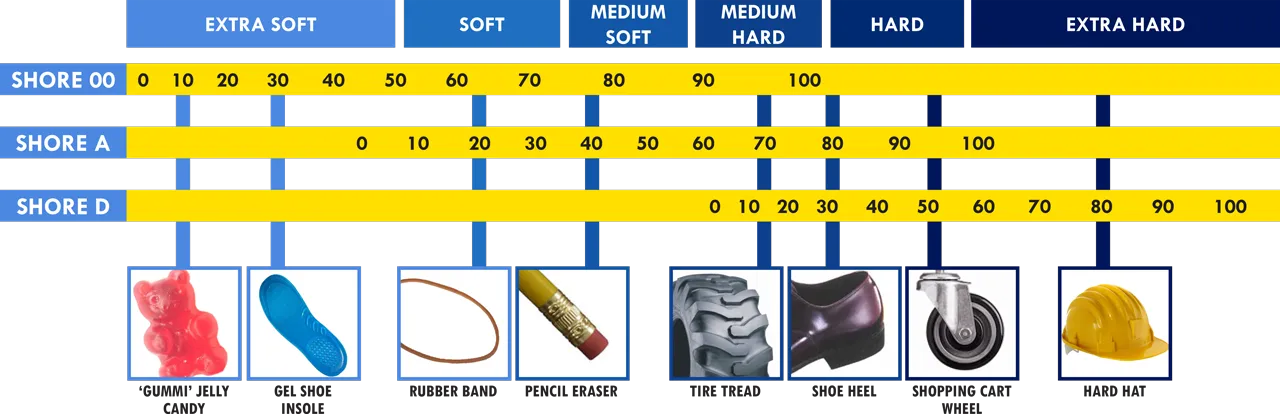
Shore hardness comparison chart: The Shore 00 scale covers very soft, gel-like materials (like gummy candies or gel insoles), while Shore A covers soft rubbers up to semi-rigid plastics. 

To put these numbers in perspective, common objects can help: a standard rubber band is around Shore A 20; a pencil eraser is roughly Shore A 40–50; typical car tire tread is about Shore A 70. That means a material at Shore A 20 is very soft and easily indented (much like a gummy candy or silicone gel insole), whereas Shore A 70 feels quite stiff (you can barely dent a car tire by pressing). Shore 00 materials are even softer – for instance, a marshmallow might be ~10 Shore 00 and a gel shoe insole ~30 Shore 00. Pet toys usually don’t go into the Shore 00 range unless they are extremely soft foam toys (which are generally not durable for chewing). In practice, pet toy materials (silicone, natural rubber, TPE) tend to span from about 15 Shore A up to 80+ Shore A in hardness, depending on the application.

How Hardness Affects Durability, Flexibility, and Safety

Hardness vs. Softness – what’s the trade-off? The hardness of a toy material directly influences its feel and performance. Softer rubbers (lower Shore values) are more elastic and compressible – they offer a gentle “mouth feel” and flexibility. This can be great for a teething puppy or a toy that needs to bend easily. However, very soft materials can also tear or abrade more easily under sharp teeth. On the other hand, harder rubbers (higher Shore values) are tough to dent or puncture – they tend to last longer against aggressive chewing and hold their shape under force. The downside is that an overly hard toy might be too rigid, less fun to chew, or even pose a risk of tooth damage if the dog bites down too hard. As one guide explains, softer silicones are gentle and flexible, whereas harder silicones provide strength for tough use – finding the balance is key.

Durability: In general, increasing hardness improves a material’s resistance to puncture and wear, up to a point. A firm silicone or rubber (say Shore A 70) will withstand powerful jaw pressure better than a Shore A 30 silicone, which a big dog could likely shred quickly. Manufacturers often formulate “tough chew” toys in the Shore A 60–80 range so they won’t rip apart under aggressive chewing. Some “indestructible” toy designs even use materials as hard as 70–90 Shore A – comparable to a skateboard wheel in stiffness – to survive the most persistent chewers. However, harder isn’t always better: if a toy is extremely hard, the pet might lose interest or risk tooth injury. That’s why one industry guideline for rubber chew balls is to avoid going too hard – “look for toys with a hardness of 60–70 Shore A” to prevent harming the dog’s teeth. In other words, the goal is maximum durability without becoming dangerously hard.

Flexibility and Bounce: Softer materials flex and stretch more. A low-durometer silicone can often elongate hundreds of percent and still spring back. This flexibility can be useful – for example, a soft rubber toy will deform under a pet’s bite, which can make it more satisfying to chew and can help scrub their teeth or massage their gums. Soft toys are also easier for pets to grip and carry. Additionally, softness can contribute to a toy’s bounce – up to a point. A medium-hard rubber ball (around Shore A 50–60) typically has a nice bounce for fetch games, whereas a very soft ball might just thud, and an extremely hard one (Shore 90+) might not bounce much either (more like a rock). Fetch toys therefore use a mid-range hardness to achieve an elastic rebound while retaining shape. For example, many high-quality fetch balls use natural rubber around Shore A 55–65, which gives a good mix of bounce and toughness (a famous example being the orange and blue fetch balls known for their high bounce, made of resilient rubber in that hardness range).

Pet Safety (Teeth and Gums): Hardness also ties directly into safety and comfort. A softer toy is gentle on teeth and gums, making it ideal for puppies, senior dogs, and any pet with sensitive mouths. Soft, flexible silicone or latex will compress under bite force, reducing the risk of tooth fractures. That’s why puppy-specific toys use softer rubber formulas – the KONG™ Puppy, for instance, uses a gentle natural rubber around 30 Shore A to protect young teeth. Conversely, a very hard toy can actually be too abrasive or rigid, potentially wearing down teeth or even cracking them if a dog bites down wrong. Veterinary dentists often warn against extremely hard chews (like some antlers or hard nylon toys) for this reason. In terms of Shore hardness, anything much above ~80A is quite stiff – not something you’d want a dog gnawing on for long. Even at 70A, caution is advised: that’s roughly the hardness of a tire tread, and while durable, it’s borderline on what a dog’s teeth should repeatedly bite. On the flip side, if the toy is too soft (low durometer) and the pet can bite pieces off easily, that’s a choking or ingestion hazard. Thus, finding the right hardness is a safety balancing act – soft enough to be tooth-friendly, but hard enough to resist being torn into small pieces. For example, a treat-dispensing toy might lean softer so it’s pleasant to chew and interact with, whereas a “power chewer” bone will be made much firmer to avoid large chunks being ripped off.

Material Composition Notes: It’s worth noting that hardness is one controllable aspect of a material’s formulation. By adjusting the silicone or rubber mix (for instance, the ratio of polymer to fillers, or the curing agent level), manufacturers can “tune” the Shore A hardness to a target value. This means the same base material can often be made in a soft version or a hard version. In our factory, we routinely customize silicone compounds in a range of durometers (e.g. offering a pet toy design in 50A or 70A as needed). Hardness will also correlate with other properties: softer elastomers usually have lower tensile strength and tear strength, while harder ones tend to have higher tensile/tear but lower elongation. For instance, a 30A silicone might stretch like crazy but tear if pulled too far, whereas a 70A silicone is strong and won’t stretch much before it snaps. These are technical nuances, but they underlie why extreme softness can compromise durability, and extreme hardness can raise brittleness – reinforcing the need for a balanced approach.

Silicone vs. Natural Rubber: Material Matters

Two of the most popular pet toy materials are silicone (synthetic rubber) and natural rubber (latex). Both are elastomers available in various hardnesses, and each has its pros and cons for pet products.

Silicone Rubber: Silicone is a lab-made polymer known for its purity and stability. High-quality silicone (especially food-grade silicone) contains no harmful additives and is free of BPA, phthalates, and latex proteins. This makes it a top choice for pet toys that might double as treat holders or that owners want to be sure are non-toxic. Silicone can also withstand extreme temperatures – it won’t deform in boiling water (helpful for sterilizing a toy) and resists UV light and weathering without degrading. In terms of hardness, silicone elastomers are typically available in roughly Shore A 20 up to Shore A 80 for solid products. Most pet silicone toys fall in the 30–70A range as a practical matter. Silicone at a given hardness tends to be a bit “springy” and has a smooth, almost silky surface feel. One thing to note: silicone’s tear strength, while decent, is often a bit lower than natural rubber’s. If a silicone toy is too thin or too soft, a determined chewer can tear it. Manufacturers compensate by designing silicone toys with thicker walls or solid shapes and avoiding sharp corners that could tear. On the whole, silicone is prized for being safe, hygienic, and fairly durable – a well-designed silicone chew toy can be very resilient, and it won’t get soggy or rot. And if your pet (or customer) has a latex allergy, silicone is a perfect latex-free alternative.

Natural Rubber: Natural rubber comes from rubber tree latex and has been used in pet toys for decades (the iconic KONG® chew toys are made of natural rubber, for example). Natural rubber is extremely elastic and generally has higher tensile and tear strength than equivalently soft silicone. This means it can often withstand aggressive chewing a bit better, especially in lower hardness ranges. Natural rubber also has a certain “bounce” and grippy texture that dogs love – it’s not as silky as silicone, which can be a pro or con depending on the toy. In terms of hardness span, natural rubber can be formulated from very soft to very hard as well. The KONG product line nicely illustrates this: KONG Puppy toys are made of a soft natural rubber around ~30 Shore A, the classic red KONG is medium firmness around ~50 Shore A, and the KONG Extreme (black) uses an extra-dense natural rubber near ~80–90 Shore A. So natural rubber covers the full spectrum from puppy-soft to power-chewer hard. A few considerations: Natural rubber is an organic material and can age – over years it might develop surface oxidation or get a bit brittle (ever seen an old rubber band that crumbles?). It also can produce a slight latex odor that some find off-putting (though pets often don’t mind). Moreover, the latex proteins can be allergens for a small percentage of people and potentially pets (though canine latex allergy is rare). Still, natural rubber is very safe for most dogs, and its performance is comparable to silicone in chew toys. Some pet brands even advertise “all-natural rubber” as a selling point. One advantage we see is that natural rubber’s high tear strength allows slightly softer formulations to be used without tearing – for instance, a 40A natural rubber toy might hold up better against tearing than a 40A silicone toy, all else equal. The choice between silicone and natural rubber often comes down to design and branding: silicone offers superior colorability, heat resistance, and chemical inertness, while natural rubber offers a classic feel and possibly better raw tear durability. Many ultra-durable toys actually blend the two (or mix synthetic rubber with natural rubber) to hit an optimal hardness and toughness.

Bottom line: Both silicone and natural rubber can be excellent for pet toys. Both can be made in a range of hardness levels to suit different needs. The key is to specify the right hardness and formulation for your particular toy’s purpose. For example, if you’re making a treat-dispensing toy that needs a bit of flex to release treats, you might choose a silicone at ~50A or a natural rubber at ~50A – either could work, and both would be safe. If you need an extreme-duty chew stick, perhaps a natural rubber at 80A or a high-durometer silicone blend is the way to go. A knowledgeable manufacturer (like us) will guide you on material selection, taking into account not just hardness but also factors like manufacturing method (injection vs. compression molding), achievable shapes, and any certifications (FDA food grade, etc.) required.

Selecting the Right Hardness for Different Pets

Not all pets play the same. A small terrier, an aggressive pit bull, a kitten, and a teething puppy all have very different toy needs. Here we break down recommended hardness ranges by pet type, to help brands and designers choose wisely:

  • Puppies (Teething or Light Chewers): For young puppies (and even senior dogs with sensitive mouths), softer is better. Typically, Shore A 15–30 is ideal for puppy toys. This softness allows the toy to compress gently, soothing sore gums and not harming baby teeth. (For context, a pencil eraser is about 30A – puppy toys are around or even below that softness.) These toys will feel very pliable if you squeeze them. Common examples are puppy chew rings or plush-filled rubber toys that you can indent with your thumb. The KONG Puppy, as mentioned, is ~30A natural rubber. Such toys might show bite marks over time (since they are soft), but that’s acceptable as long as chunks aren’t coming off – the goal is a comfort chew. Manufacturers may design these toys to be thicker or in gentle shapes to compensate for the lower material strength at that softness. Always ensure puppy toys are non-toxic and free of loose bits, since puppies will mouth them a lot.

  • Small Dogs (Adult small breeds, moderate chewers): Smaller dogs (e.g. under 20 lbs) often do best with a medium-soft to medium hardness – roughly Shore A 30–50 range. Why? A tiny dog’s jaw can’t typically generate the force of a large dog, so they don’t need an ultra-hard material to get durability. In fact, if it’s too hard (say a 70A toy), a small dog might not even be able to compress it at all, making the toy uninteresting. So for small breeds, we often recommend somewhere around 40A–50A: firm enough to last, but with a bit of “give” when they bite. Around Shore 40–50A, a toy is about as hard as a car’s rubber door seal or a shoe sole – you can flex it, but it’s tough. Many generic rubber toys and balls marketed for small dogs fall in this middle ground. It’s also a safe zone in terms of not damaging their smaller teeth. If the dog is an aggressive chewer despite its size, lean to the upper end (50–55A) and use a tear-resistant formulation. If the dog is gentle, you could lean softer (30–40A). Also consider toy size – small dogs need physically smaller toys, which in turn should usually be a bit softer because there’s less bulk to withstand force. (Pro tip: a thin toy made of very hard rubber can crack; if you must use a hard material, ensure the design is thick enough.)

  • Large Dogs & Aggressive Chewers: For big breeds or any dog that’s a notorious power chewer (regardless of size), harder materials are warranted. These pets can crunch through flimsy toys in minutes. Typically we suggest Shore A 60–80 for aggressive chewers. At ~60A and above, rubber starts to get quite tough – a human can barely dent it with a fingernail. Chew toys in this category (think of black “extreme” rubber toys, heavy-duty rubber balls, etc.) will hold up far better under strong jaws. For example, an “indestructible” chew stick might be made of 70–75A rubber (comparable to a skateboard wheel or hard hat in stiffness). Some extreme toys even go nearly to 90A (though we caution, beyond ~85A you risk the toy being too hard for safe chewing, as discussed). A good strategy is multi-layer construction: some high-end chew toys have a tough core around 60–65A and a slightly softer outer layer around 45–50A. This gives a bit of a cushion on the surface but a durable heart inside. If you design a toy for aggressive chewers, you’ll also want to ensure it’s physically large enough that the dog can’t fit the whole thing in its mouth (to prevent choking) and that there are no weak points (like narrow appendages) that invite tearing. Material-wise, natural rubber is popular for these tough toys (it can be formulated very hard but still with slight elasticity). Reinforced TPR (thermoplastic rubber) blends are also used around 70–80A. And some brands use nylon or polypropylene elements for ultra-hard parts, but those are plastics on a different hardness scale (and not “soft” at all – more like bone). As a silicone manufacturer, we’d note that silicone in the 80–90A range can be made, but it’s quite rigid – often, we’d instead recommend a composite of silicone and fabric or a dual-hardness approach for extreme chewers. In summary, give your power chewer toys a fighting chance by using very firm, high-durometer rubber – just don’t exceed what’s safe for teeth (usually max ~90A).

  • Cats: Feline play behavior is different from dogs – cats are generally not chewing with massive force, but they do claw, bite lightly, and carry toys in their mouth. Many cat toys are actually plush or hard plastic, but there are silicone and rubber cat toys too (e.g. treat-dispensing cat toys, cat chew toys for dental health, or interactive balls). For cat applications, softer rubber is usually preferred, both to entice the cat and for safety. A cat’s teeth are small and sharp; a very hard material provides no satisfaction for them to bite and could even crack a tooth (yes, cats can fracture teeth on very hard objects too). Thus, we’d recommend cat chew toys be around Shore A 20–40, on the softer side. This gives a nice squishy feel if a cat gnaws on it and is gentle on their teeth. Soft silicone also has an interesting “mouthfeel” that some cats like (similar to how they chew on soft silicone straws or earbuds). If the toy is a ball or something meant to be batted around, a medium firmness (around 40A-50A) might be used to ensure it’s durable and bouncy enough – but in those cases, the cat isn’t usually biting hard into it. Cat treat-dispensing toys (like little food-dispensing balls) could be in the 40–50A range for a bit of bounce and to hold their shape. One thing about cats: they are lighter and generally don’t destroy toys the way dogs do, so durability is less of a concern except for scratching. A softer toy (say 30A silicone) will hold up fine to cat claws and occasional nibbling, as long as it’s thick enough. And since cats often like to carry toys in their mouth, the lightweight nature of a softer silicone is a bonus. In short, for cats we lean soft – you’re rarely going to need a “hard” rubber for a cat product, and keeping it soft makes the toy more attractive for them to pounce, kick, and lightly chew.

Typical Hardness Ranges by Toy Type

Another way to choose material hardness is by considering the type of toy you’re making. Chew toys, fetch toys, and treat toys each have different functional requirements:

  • Chew Toys: This category covers toys meant to be gnawed on for extended periods (rubber bones, chew sticks, dental chews, etc.). The hardness depends on the target chewer. For a gentle chew toy or puppy chew, you might go as soft as Shore A 20–30 (very soft, as discussed). For a standard all-purpose dog chew toy, somewhere around Shore A 50–60 is common – durable but still with some flex. And for heavy-duty chew toys marketed as “tough” or “indestructible,” you’ll see Shore A 70–85 materials. For example, a thick rubber dental chew for aggressive chewers might be ~75A so that the teeth sink in only slightly (just enough to clean), and the toy doesn’t chunk off. Always err on the side of a little softer if unsure, because a chew toy that’s slightly too soft will just get cosmetic damage, whereas one that’s too hard could hurt a dog’s teeth. Many brands have tiered product lines: e.g., “soft chew” for seniors/puppies (around 30A), “medium chew” for average dogs (~50A), and “power chew” for strong jaws (~70A+). Our factory can produce custom hardness chew toys to fit those tiers easily. Also, squeaky chew toys (like squeaker balls or squeaky rubber bones) usually need to be in the mid-range hardness. They must be soft enough to depress and allow the squeaker to function, but hard enough to last. Typically, a squeaky rubber ball might be around 60–70 Shore A – as one buyer’s guide notes, that range avoids the toy being so hard it harms teeth, yet is firm enough to be durable.

  • Fetch Toys (Balls and Flyers): Fetch toys like balls, discs (frisbees), and tug toys have to handle impact (being thrown, bouncing, etc.) and often need good bounce or flight. Balls: A good fetch ball is usually a medium-firm natural rubber. Common hardness here is around Shore A 50–65. At ~50A, a ball has a nice bounce and can deform a bit when the dog grabs it, making it easy to pick up. Hardness much above 65A and the ball might get too stiff (and heavy) to have an exciting bounce – plus it could be unpleasant for the dog to catch. The popular Chuckit! Ultra Ball for example is lauded for durability and bounce; while we don’t have exact specs, the feel suggests it’s in that mid-durometer range (not squishy, but you can indent it a little by pressing). Flying discs (rubber frisbees): These need flexibility so they don’t crack, but also enough stiffness to hold a disc shape. Silicone or rubber flying discs are often around Shore A 40–60. A 40A disc will be very flexy (able to be crumpled up, good for safety), whereas a 60A disc is more rigid for longer flights. One of our customers makes a silicone fetch disc at ~50 Shore A – it can fold in your hand but flies decently, and if the dog bites it mid-air it flexes without hurting their mouth. Tug toys (rubber tugs or rings): They’re a bit different since they undergo pulling rather than impact. But generally, a tug toy made of natural rubber might be around 50–70A. You want it tough (to resist tearing when two dogs or a dog and human play tug-of-war), but if it’s too hard, it won’t have the enjoyable stretch. Many tug toys use reinforcement (like rope inside rubber) so hardness is less critical than design. Lastly, consider that fetch toys often double as chew toys when the dog is alone – so if you know the ball will be chewed, maybe opt for the higher end of hardness for durability. On the other hand, if you’re designing an indoor fetch toy or a light play ball, a softer material (even 30–40A) could be nice to avoid breaking lamps and to be gentle in the dog’s mouth. We’ve seen silicone spiky balls for dogs that are very soft (around 25A) intended for gentle indoor fetch and massage, for instance.

  • Treat-Dispensing Toys (Puzzle Toys): Treat or food-dispensing toys (like fillable rubber toys, slow-feed balls, etc.) have a unique goal: they should be firm enough to hold their shape with food inside, but ideally somewhat soft so the dog can bite and squeeze them to extract treats. The classic example is the KONG Classic, a treat-stuffable toy which is about Shore A 50 in hardness (medium firmness). That choice of hardness lets it flex when the dog chews, so treats can fall out or be worked out, but it’s not so soft that pieces tear off when the dog is focused on it. Generally, 40–60 Shore A is a good window for treat-dispensing toys. At 40A, the toy is quite soft – easy for a dog to compress, maybe suitable for mild chewers or for cold conditions (some treat toys are meant to be frozen with goodies inside, so they chose a softer base rubber knowing it will stiffen slightly when frozen). At 60A, a treat toy will be tougher and last longer, suited for dogs that would otherwise destroy a softer one. One manufacturer we know uses about 50A food-grade silicone for their treat puzzle toys, finding it a “sweet spot” that’s both flexible and durable. Also, treat toys often get gnawed continuously as the pet tries to lick out peanut butter or kibble, so the material must withstand a lot of repeated biting. We ensure our silicone for these toys has good tear strength (often adding a reinforcement or using a high-strength grade) so that even at 50A it doesn’t split at the opening. In summary, for puzzle toys: aim mid-range hardness; soft enough for interactivity, tough enough for longevity. (And always food-safe material since treats will be in contact – silicone shines here due to its inertness.)

Of course, there are other toy categories (e.g. interactive electronics encased in silicone, which often use soft silicone for a nice feel, or edible chews, which are another realm entirely). But for most solid silicone/natural rubber toys, the above guidelines apply. The main point is to match the hardness to the use case: softer for comfort and gentle play, harder for durability and challenge. When developing a new toy, think about the target pet and the toy’s purpose – this will guide the durometer choice. We often prototype a design in two or three hardness levels and do pet testing to see which performs best.

Manufacturing Testing and Quality Control

From a manufacturer’s perspective, ensuring the toy has the specified hardness and quality is crucial. In our silicone factory, we have strict quality control practices to verify every batch of toys meets the target specifications and safety standards:

  • Hardness Testing (Durometer Checks): We measure the Shore hardness of each production batch using calibrated durometer instruments. According to ASTM D2240 (the standard for Shore hardness), the test samples should be a certain thickness (at least 6 mm) and we take the reading ~1 second after pressing to get a consistent value. Our QC technicians use a Shore A durometer for most pet toys (and Shore 00 if we ever do very soft gels) to make sure, for example, that the “50A” toy you ordered is indeed 50A ± a small tolerance. If the hardness reading falls outside the agreed range, we adjust the material mix and re-mold. Maintaining consistent hardness is important not just for performance but also for customer expectations – a batch of toys that come out too soft might wear out faster, while too hard could violate safety aims. Therefore, hardness testing is a routine step in our production process. We use both analog and digital durometers, and they are regularly calibrated against reference blocks.

  • Tensile and Tear Strength Testing: Alongside hardness, we often test the tensile strength (how much pulling force the material can withstand) and tear resistance of the rubber compound used. This is done with specialized equipment like a tensile tester (which stretches sample strips of the rubber until they break). For tear, we might use a trouser tear test or similar per ASTM standards. These tests ensure that if we have formulated a softer rubber, it still has adequate strength to not split when a dog is chewing. For instance, if a certain Shore A 30 silicone isn’t meeting our tear strength criteria, we might need to modify the formulation (e.g. add a reinforcing filler or slightly increase hardness) before mass production.

  • Bite/Chew Simulation Tests: A very informative test we do for chew toys is a mechanical chew simulation. One setup involves a pneumatic or motor-driven clamp that repeatedly compresses the toy or a test slab of the material to mimic a dog’s bite. We might also perform a kind of “puncture” test using metal probe heads of various shapes (simulating canine teeth) to see how the material holds up. According to one pet toy company, rigorous durability testing can involve over 10,000 bite cycles on a toy to ensure it doesn’t tear or deform excessively. We adopt a similar mindset – for any new design, we’ll put it through cyclic chewing tests and inspect for damage. If a toy is meant for power chewers, we test it under even more extreme conditions (higher forces, more cycles). These tests help catch issues like weak spots or potential choke-hazard pieces coming loose.

  • Safety and Chemical Tests: We ensure all our silicone and rubber raw materials are certified non-toxic. This includes checking for things like lead, BPA, phthalates, or other harmful substances (many of the same tests as children’s toys, even though pet toys aren’t always legally held to that standard). For silicone, we often use platinum-cured, food-grade silicone that’s FDA/LFGB compliant. For natural rubber, we make sure it’s purified and free of nitrosamine-producing chemicals, etc. We also test that colors are colorfast and won’t leach dye when the toy is chewed or washed. Some clients ask for specific certifications or testing (for example, EU REACH compliance or California Prop65). Quality control in this area means working closely with material suppliers and sometimes sending toys to independent labs (like Eurofins or SGS) for analysis. A passed chemical safety test is as important as the physical durability.

  • Dimensional and Visual Inspection: Hardness aside, each toy is inspected for proper molding – no excess flash, no air bubbles or voids, no sharp edges. We verify that any design features (like treat holes, squeaker inserts, etc.) are correctly formed. If two materials are over-molded (say a hard core and soft outer layer), we check the bond strength between layers. Throughout a production run, our team does regular spot checks (for example, 10+ regular checks and 5 random checks per order as one quality plan) to catch any deviations. We use tools like calipers to measure critical dimensions and ensure consistency.

  • Hardness Tuning and Process Control: Achieving the desired hardness reliably is partly an art of compounding and processing. Our engineers control parameters like mixing time, temperature, and cure time precisely to hit the target durometer. For instance, longer cure or more curing agent can increase hardness in many rubber systems. We document these process settings so that once the ideal hardness is dialed in during prototyping, we can reproduce it for mass production. If a client wants two hardness options for a toy (say a 50A and a 70A version), we will have two separate formulations and possibly molding setups, and we keep strict separation to avoid any mix-ups.

  • Field Testing and Feedback: As a final quality step, we often conduct or encourage real-world testing of our toys. We provide sample toys to a few pet owners or even have an in-house test dog squad (some employees’ dogs volunteer!) to play with new toys. Their feedback – how quickly does the toy wear, do they show interest, any unexpected issues – is invaluable. This isn’t a quantifiable test like durometer reading, but it’s a key part of quality assurance for pet products. It helps verify that our lab testing correlates with actual pet usage. For example, a lab machine might not fully replicate a dog’s chewing pattern of “hold in paws and gnaw on one end,” so a dog test might reveal a weak point we didn’t anticipate. We treat these insights seriously and iterate the design or material if needed.

Through all these practices, the goal is to deliver consistent, safe, and effective pet toys. Whether it’s a silicone cat ball at 25A or a tough rubber stick at 80A, our factory’s quality systems make sure the hardness is on target and the toy will perform as promised when it’s in a pet’s jaws. We want pet brands to have confidence that when we say “this toy is suitable for aggressive chewers,” it truly has been engineered and verified to meet that claim.

Conclusion

Shore hardness might be a technical metric, but as we’ve seen, it has a very tangible impact on pet toy performance. The difference between a 30A and a 70A material in a chew toy could be the difference between a toy that’s shredded in minutes and one that lasts for months – or the difference between a toy a teething puppy loves and one it won’t touch. By understanding Shore hardness and choosing the right softness/firmness for the specific pet audience, brands can dramatically improve their toys’ success in the market. The sweet spot is always a balance: durable yet not dangerously hard, flexible yet not flimsy.

As a silicone manufacturing partner, we speak this language of durometers daily. We’re here to help pet product designers navigate these material decisions. Choosing the right material and hardness is not a one-size-fits-all formula – a lot depends on the pet’s size, age, chew strength, and the toy’s purpose. Our team can advise whether a high-tear natural rubber might suit your design better, or if a silicone of a certain Shore A with a specific additive would give the best results. We can even produce sample pieces in multiple hardness levels for you to evaluate.

Collaborate with your manufacturer early in the design process to dial in the hardness – it can save time and cost later by preventing failures or redesigns. If you’re developing a new pet toy (be it a chew, fetch, or treat toy), we encourage you to consult with us or another experienced materials supplier. We’ll help you select the optimal softness for safety and fun, and ensure rigorous quality control so every unit meets those standards. In the end, our goal aligns with yours: to deliver pet toys that are safe, high-quality, and tail-waggingly enjoyable.

Ready to create the perfect pet toy? Feel free to reach out to our team for expert guidance on silicone and rubber materials. With the right Shore hardness and our manufacturing know-how, your next pet toy product can truly stand out in durability and pet-approved performance. Let’s work together to make toys that pets love and owners trust!

Silicone shoulder pads have become a game-changer in fashion, offering a blend of comfort, aesthetic enhancement, and practicality. As a silicone manufacturing expert, I will guide you through the full custom manufacturing process of these pads – from initial concept and design, through material selection and molding, to the final finishing and integration into garments. The goal is to demystify how custom silicone shoulder pads are made and explain each step in an authoritative yet accessible manner. Whether you are a fashion designer, an apparel brand, or an OEM buyer, this comprehensive walkthrough will clarify the techniques, terminology, and choices involved in creating high-quality silicone shoulder pads for clothing.

Concept and Functional Design in Fashion

Every great product starts with a clear concept. In fashion, silicone shoulder pads are conceived to solve specific design and comfort challenges. Designers use these pads to subtly enhance the shoulder line – correcting sloped or uneven shoulders and providing a smooth, broad-shouldered silhouette under clothes. Beyond aesthetics, the pads add functional benefits: they cushion the shoulder for comfort and improve garment fit by helping garments drape correctly. For example, a lightweight jacket or blouse can instantly gain structure and better posture appearance by the insertion of silicone shoulder pads, giving the wearer a more confident stance.

shoulder padsSilicone shoulder pads adhere to the shoulder, providing a contoured shape and staying in place. They are smooth yet slightly textured for grip, with tapered edges that lie flush against the skin so they won’t show or slip during wear. Such pads are self-adhesive, reusable, and conform to the body’s shape, enhancing comfort and silhouette.

During the concept phase, fashion designers and product developers collaborate to define the pad’s shape, thickness, and placement. Key considerations include the desired shoulder profile (e.g. subtle lift versus dramatic angular shoulders), the target garment type (formal jackets, dresses, costumes, etc.), and wearer comfort. Often a functional design brief is written, outlining requirements like:

  • Contours & Shape: Should the pad create a rounded shoulder or a sharper edge? The shape must blend with the garment’s style and the human shoulder anatomy for a natural look.

  • Coverage Area: The pad’s size (length and width) determines how much of the shoulder it covers. A larger pad distributes weight and pressure, while a smaller pad targets a specific area for lift.

  • Thickness & Gradation: Pads are usually thicker at the highest point of lift and taper to thin edges. Uniform tapering ensures a smooth transition under the fabric, avoiding visible lines.

  • Attachment Method: Will the pad be sewn into the garment, inserted into a pocket, or simply placed on the shoulder with an adhesive backing? This affects design features like adding a fabric flap for sewing or choosing a tacky silicone formulation for stick-on pads.

Ergonomics play a big role at this stage. The pad must conform to the shoulder’s curves without impairing movement. Designers might start with sketches or even clay models placed on mannequins to visualize the effect. Increasingly, 3D design software is used to model the shoulder pad concept. Using CAD (Computer-Aided Design) or specialized fashion simulation tools, one can create a virtual shoulder pad and test how it looks under various garment designs. For instance, 3D fashion simulators allow designers to virtually insert a shoulder pad model under a digital garment pattern to ensure the pad yields the intended silhouette and stays hidden. This digital prototyping saves time and helps catch design issues early, such as the pad being too large for a given shoulder seam or not aligning with the garment’s shoulder slope.

Prototyping and 3D Modeling Process

Once the initial concept is defined, the next step is prototyping – creating a tangible model of the silicone shoulder pad. Prototyping confirms the design’s feasibility and allows testing of the pad in actual garments. There are multiple prototyping methods for silicone parts, each with its advantages, and the choice often depends on how quickly and accurately a model is needed:

  • 3D Printing of Silicone or Molds: Emerging technologies enable direct 3D printing of silicone or printing a mold to cast silicone. Silicone 3D printers can produce complex shapes without a metal mold, which is great for rapid iteration; however, very fine details or ultra-smooth surfaces might be harder to achieve.

  • Casting in Prototype Molds: A quick mold can be made from inexpensive materials (like 3D printed plastic or epoxy) to cast a silicone prototype. This room-temperature vulcanization (RTV) molding uses liquid silicone poured into a soft mold and cured. It yields a high-fidelity part but can be labor-intensive for each iteration.

  • Compression Molding Prototypes: If the production intends to use compression molding, a simple aluminum prototype mold can be CNC milled. A small amount of silicone rubber is then press-molded to create a prototype pad. This method produces an end-use quality part quickly and is cost-effective if the mold is simple.

  • Injection Molding Prototypes: For more complex or precise pads, one may invest in a single-cavity liquid silicone injection mold even for prototyping. Although expensive, it produces a part identical to mass production and can reveal any issues with mold design or material flow early on.

The prototyping stage will usually start with a 3D CAD model of the shoulder pad, based on the concept. The engineering team refines this model, paying attention to design-for-manufacture principles specific to silicone. One important guideline is to maintain a uniform wall thickness throughout the pad as much as possible. Unlike thermoplastic parts, silicone rubber doesn’t shrink drastically as it cures, but uneven thickness can cause unequal curing (thicker areas might cure more slowly or become too firm). Uniform thickness also ensures that pressure and heat distribute evenly during molding, yielding consistent material properties. Another design tip is to avoid sharp corners or edges on the pad design. Silicone is very elastic, but a sharp corner can tear when the pad is demolded from a tight mold corner. Thus, all edges and transitions in the CAD model are given smooth radii and fillets for strength.

After a CAD model is completed, a feasibility analysis is often performed. Engineers simulate how silicone will flow into the mold (if injection or compression molding) and where any air traps or weak points might be. Based on these analyses, the design might be tweaked – for example, adding a slight draft angle to the pad’s sides so it can release from the mold more easily, or adjusting the pad’s curvature to better match shoulder anatomy. Once the design is approved, the team creates the first physical prototypes using one of the methods above. These prototypes are then inspected and tested:

  • Fit Test: The prototype pad is placed on a dress form or worn by a fit model under a garment to ensure it achieves the desired silhouette and that it stays in place.

  • Comfort Test: Designers assess if the pad feels comfortable on the shoulder – the silicone should be soft enough not to dig into skin and the pad should flex with movement.

  • Garment Integration Test: If the pad will be sewn or inserted, the prototype is attached to a sample garment to see how easy it is to integrate (for example, can a tailor easily stitch it in? does it require modifications to the garment lining?).

Feedback from these tests might send the design back for adjustments. It’s common to go through a few prototype iterations until the pad’s shape, size, and functionality are perfected. Only then does the project move into sourcing the final production materials and creating production tooling.

Silicone Material Selection: Flexibility, Durability, and Safety

Choosing the right silicone material is a critical step, as it determines the pad’s feel, performance, and safety. In the realm of silicone rubber, there are two main categories to consider:

  • High Consistency Rubber (HCR) Silicone: Also known as solid silicone or heat-cured silicone, HCR comes as a malleable, clay-like gum. It typically requires compounding with additives and is cured by heat (often with peroxides or platinum catalysts) in compression molds. HCR is known for its robust properties and is used in demanding industrial parts (e.g., automotive gaskets). For fashion shoulder pads, HCR could be used if one opts for compression molding production. It offers durability and can be formulated in a range of hardnesses.

  • lsr-silicone-rubberLiquid Silicone Rubber (LSR): LSR is a two-part liquid silicone that is mixed and injected into molds, curing into a flexible solid. LSR is odorless, non-toxic, and highly biocompatible, making it extremely safe for skin contact. It’s often the preferred choice for consumer products that touch skin (baby products, medical devices, wearables) because it’s hypoallergenic and does not leach harmful substances. For shoulder pads, LSR provides a soft, gel-like consistency and can be colored or made transparent.
Both HCR and LSR can produce excellent shoulder pads, but they affect the manufacturing method. Compression molding typically uses HCR, while injection molding uses LSR. Material choice might depend on the production volume and the qualities desired in the final pad. LSR, processed via injection, yields very high consistency and is ideal for mass production of identical pads. HCR, processed via compression, might be more practical for smaller runs or very large pad shapes, and it allows hand-adjusting the material placement in the mold.

Silicone itself has many properties that make it ideal for fashion padding:

  • Flexibility and Softness: Silicone’s elastomeric nature means a pad can flex with the wearer’s movements and recover its shape. By selecting the silicone’s durometer (hardness), manufacturers can tailor how soft or firm the pad feels. For example, a Shore A hardness around 20–30 (fairly soft) might be chosen for a gentle, gel-like shoulder pad feel. Hardness is measured after curing with a durometer device to ensure it meets the specification.

  • Durability: Silicone rubber is very durable – it resists tearing and can undergo repeated compression without permanent deformation. A well-made silicone pad won’t crumble or break down over time like some foam pads can. It also tolerates a wide temperature range and UV exposure, so it won’t degrade if a garment is stored in a hot car or under strong lights.

  • Hypoallergenic and Skin-Friendly: High-quality silicone is biocompatible and non-irritating to skin, containing no latex or harmful plasticizers. This is crucial since shoulder pads may directly touch the wearer’s skin (especially in sleeveless outfits). Indeed, products on the market emphasize that their silicone pads are skin-friendly and not likely to cause allergies or irritation. Silicone is also odorless and will not develop odors over time, an advantage over some foams that can absorb sweat.

  • Grip and Anti-Slip: Silicone has a naturally slightly tacky surface, which can be an advantage for shoulder pads – it helps the pad grip the skin or fabric and stay in place. This anti-slip quality can be enhanced by surface texture. Some pads intentionally have a textured surface pattern to increase friction so they “do not fall off” easily.

  • Weight: Silicone is denser than foam, so pads will have a bit of weight to them (which can help them stay put by gravity). However, they are still light enough for comfort. If weight is a concern, designers can incorporate cut-outs or hollow sections in the pad design to reduce material use.

  • Custom Colors & Transparency: Silicone can be mixed with pigments to virtually any color, or left uncolored for a translucent look. Fashion pads often come in clear or skin-toned silicone for discretion. A clear pad is nearly invisible under sheer fabrics, while a skin-tone pad blends against the wearer’s complexion. Black or other colors might be used if the pad is meant to match a garment or be visibly decorative.

For a given project, the manufacturing team will source a specific silicone formulation from a silicone supplier. They consider the shore hardness, tensile strength, and tear resistance specifications needed. In some cases, specialty silicone might be used: for example, a foam silicone (cellular silicone) could make a lighter, cushier pad; or an adhesive silicone gel might be chosen if the pad needs to stick directly to skin. All materials must, of course, comply with relevant safety standards (such as being free of harmful substances like lead or BPA, and meeting any applicable textile regulations). Fashion brands often require that the silicone be certified to REACH or similar standards for safe use in apparel, especially if the products will be sold in markets with strict chemical safety regulations (EU, US).

In summary, material selection boils down to finding a silicone that meets the comfort needs of the end-user and the processing needs of manufacturing. With the design finalized and material chosen, the project moves to the tooling stage – creating the molds that will shape the silicone pads.

Mold Making and Tooling for Silicone Pads

Tooling refers to the creation of the mold or molds in which the silicone will be shaped. This is a crucial step because the mold’s quality and design directly impact the pad’s final shape, surface finish, and how easily it can be produced. For custom silicone shoulder pads, typically metal molds are used for production, even if prototypes might have used cheaper materials. The common process is:

  • Designing the Mold: A mold engineer takes the 3D CAD model of the shoulder pad and designs a matching mold cavity. For a simple pad, the mold might be a two-part (upper and lower plate) design, where the cavity is the negative of the pad’s shape cut into the metal. The engineer decides on the mold layout: for instance, will one mold produce one pad at a time or multiple pads (multiple cavities) per cycle? If high volume is expected, molds can be made with multiple cavities to produce many pads with each press or injection cycle.

  • Choosing Mold Material: For production volumes, steel molds (often P20 tool steel or hardened steel) are favored for their durability – they can withstand hundreds of thousands of cycles. If the production run is modest or speed is of the essence, aluminum molds are an option; aluminum is faster to CNC machine and polish, but wears out faster especially under the heat and pressure of silicone molding. For initial low-volume production or prototyping, aluminum is a cost-effective choice. In either case, the mold material must withstand curing temperatures (typically 150–180°C for silicone) and the clamping pressure of the molding machine.

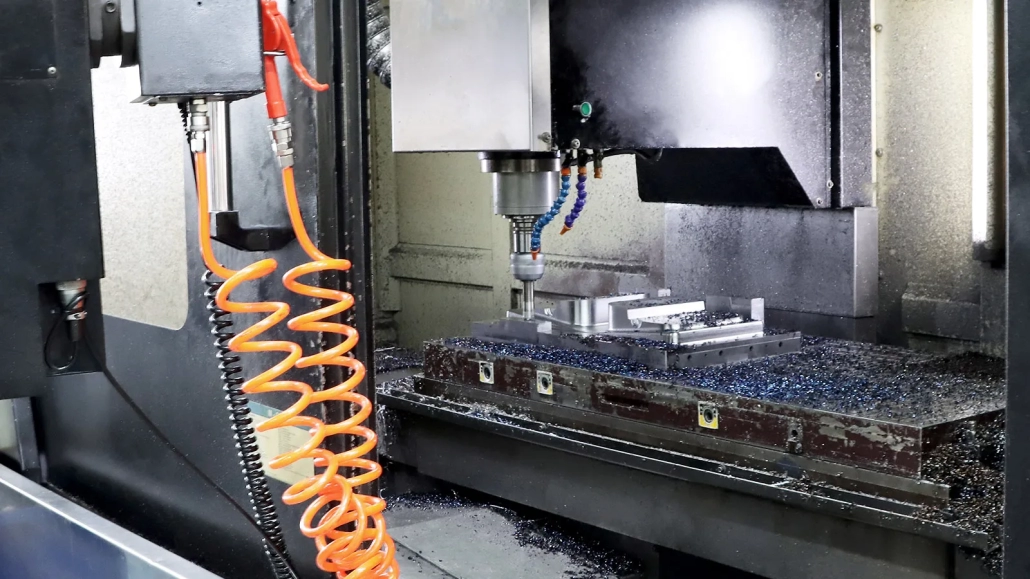
  • CNC Machining or EDM: The mold cavities are typically cut using CNC (Computer Numerical Control) milling machines that precisely carve the metal according to the 3D design. Intricate details or fine textures might be added using EDM (Electrical Discharge Machining), which can create very precise features by eroding metal with sparks. For instance, if the pad’s surface needs a micro-texture (to mimic skin or fabric, or to increase grip), EDM can imprint that. Conversely, if a glossy smooth finish is desired on the pad, the mold cavity is polished to a mirror shine.

  • Parting Line and Vents: The engineer must plan where the parting line of the mold will be – that is, where the two halves of the mold meet. Ideally, the parting line on the pad will fall in a less visible area. On a shoulder pad, a common approach is to have the parting line along the thin perimeter edge of the pad. This way, any slight flash or seam will be at the very edge where it’s least noticeable and can be easily trimmed. Tiny vent holes are drilled at the edges of the cavity to allow air to escape when silicone flows in, preventing air pockets.

  • Gates and Runners (for Injection Molding): If the pad will be made by LSR injection molding, the mold design also includes gate and runner systems. Liquid silicone is injected usually through a gate into the cavity. A well-designed gate location is critical – for example, placing a gate at a thick section can help fill the pad without trapping air. For aesthetic parts like fashion pads, molders try to put the gate in a non-obvious spot (perhaps on the underside of the pad or on an edge that will be trimmed). A cold-runner or hot-runner system might be used to deliver the two-part LSR into each cavity efficiently, minimizing waste. Injection molds also often include automated systems to de-mold parts (like ejector pins or plates) because the process is highly automated.

  • Mold Trial and Finish: After the mold is fabricated, it’s tested by doing a trial molding with silicone. This trial might reveal any necessary tweaks – for example, if the pad isn’t filling fully, the mold maker might enlarge a gate or add another vent. Once everything is working, the mold surfaces are given a final finish. As noted, a polished surface can help the pad release easier and gives the pad a smooth feel, whereas a textured surface can give the pad a matte look or better grip. Polishing the mold is particularly important for LSR molds, as it reduces friction so that the cured silicone part will peel out without sticking excessively.

Building a high-quality mold can be one of the longer lead-time items in the project. However, the investment pays off in production. A good mold ensures repeatability – every pad comes out with the same shape and dimensions – and minimizes defects. Also, when cared for, a steel production mold can be used for many production runs, making future batches of pads consistent with the first.

In summary, the tooling phase translates the silicone pad design into a precise metal cavity ready for manufacturing. Now let’s look at how the actual molding – the process of turning raw silicone into the final pad shape – takes place.

Molding Methods: Compression Molding vs. Liquid Injection Molding

The two primary molding methods to produce silicone shoulder pads are compression molding (using HCR silicone) and liquid injection molding (using LSR). Both processes involve placing silicone into the mold cavity and heating it to cure, but they differ in how the silicone is introduced and how automated the process is. We’ll explore each method:

Compression Molding Process

Silicone-Compression-Molding-Process

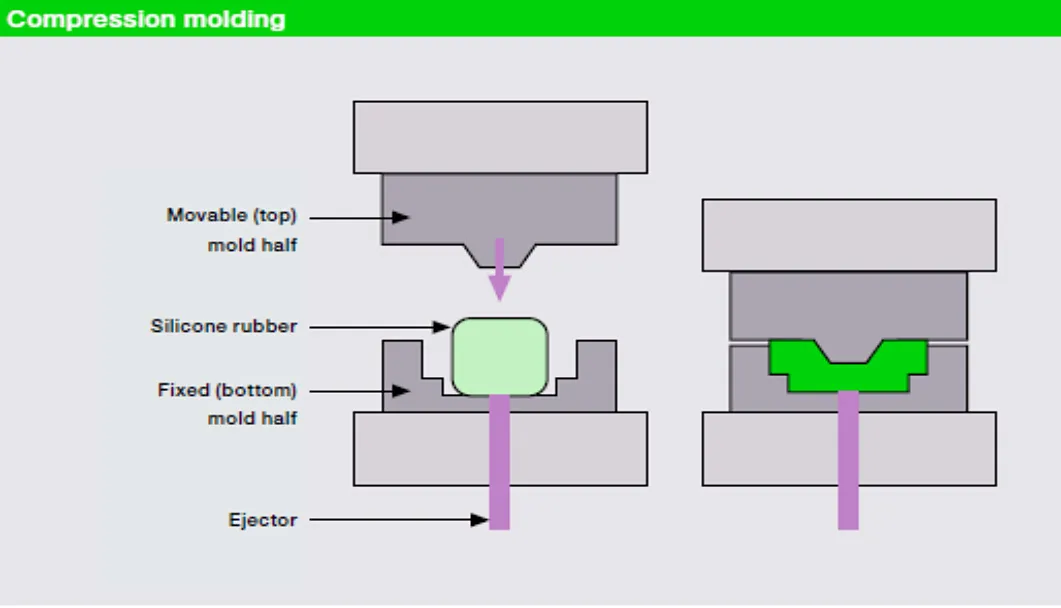
Compression molding is a straightforward and time-tested method for shaping silicone rubber. It’s especially suitable for relatively simple parts and moderate production volumes. In compression molding of shoulder pads, the steps are as follows:

  1. Material Preparation: The silicone (usually HCR gum) is first mixed and prepared with any necessary ingredients. Raw silicone gum by itself has no color and limited elasticity, so it’s compounded with additives: for example, pigments to get the desired color, curing agents (peroxide or platinum catalyst) to enable it to vulcanize, and possibly reinforcing fillers (like silica) to improve tear strength. Once mixed, the silicone compound might be milled into flat sheets or strips of appropriate thickness.

  2. Pre-measuring & Loading: A piece of uncured silicone, often called a “preform,” is cut to size for the mold. The amount must be carefully weighed to slightly overfill the cavity – too little material and the pad will have voids, too much and excess will flash out of the mold. The operator places this piece of silicone into the open mold cavity. For a shoulder pad shape, they might center a roughly pad-shaped slug of material on the lower mold half.

  3. Closing and Curing: The mold is closed, and a press applies high pressure while heating the mold. Under heat (typically 150°C or more) the silicone softens and flows to fill the cavity, and then cures into a solid elastic state. Curing time can vary, but often on the order of a few minutes per cycle for silicone pads. During this phase, some silicone will inevitably squeeze out along the parting line of the mold – this forms the thin excess known as flash. Because in compression molding the raw material was exposed when the mold closed, a thin flash line around the pad’s edge is expected. In well-controlled processes, this flash is very thin (industry standards allow flash under about 0.25 mm), but it will need trimming later.

  4. Open and Demold: After the cure time, the press opens and the operator removes the molded pads. Often the pads will stick lightly to one side of the mold – operators might flex the mold or use a gentle air jet or their fingers to peel the pad out. The pads are removed while warm. At this stage, they have the exact shape of the cavity, including any textures or logos that were engraved in the mold.

Compression molding has the benefit of being simpler and often cheaper to set up than injection molding. The equipment is usually a basic heated press, and the molds do not require complex runner systems. It’s a great method if a manufacturer wants to quickly produce a batch of custom pads without investing in the full automation of injection. However, compression molding is more labor-intensive – each cycle might require manual loading and demolding – and it typically results in that ring of flash that must be trimmed off.

Liquid Silicone Injection Molding (LSR Molding)

silicone-injection-molding-pocess

Liquid Silicone Rubber (LSR) injection molding is a more advanced process that offers high precision and automation. If the project demands large quantities of shoulder pads with consistent quality, injection molding is the preferred method. Here’s how it works for silicone pads:

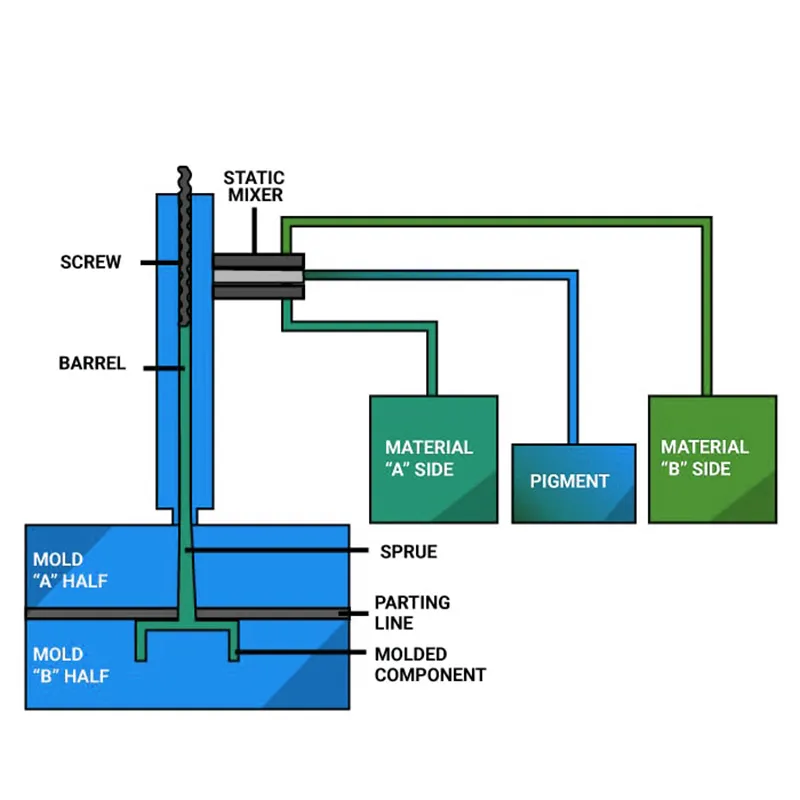
  1. Material Mixing and Metering: LSR comes as two liquid components (Part A and Part B) that are stored in drums. These parts are pumped into a metering unit that precisely mixes them at a 1:1 ratio (along with any liquid pigment or additives). The mixture starts to cure only when the two parts meet, so the system keeps them separate until just before injection. The mixed LSR is then pushed into the injection molding machine barrel.

  2. Injection into Closed Mold: Unlike compression, the mold in an LSR machine stays closed and clamped shut before silicone is introduced. The machine injects the liquid silicone through sprues and runners into the cavities. Because the mold is already closed and under clamp force, the silicone fills the cavity completely without opening the mold. The mold is maintained at the curing temperature (usually slightly lower than for compression, around 100–130°C for LSR, since LSR cures fast).

  3. Curing and Crosslinking: Once injected, the silicone quickly cures in the heated mold, taking as little as 30 seconds to a couple minutes depending on part size and the silicone formulation. LSR has a lower viscosity than HCR, so it can fill very intricate details and thin sections reliably. Its curing time is also faster, roughly one-third that of solid silicone under equivalent conditions, allowing faster cycle times.

  4. Automatic Demolding: Many LSR molds are designed so that when the mold opens, the finished parts are either ejected automatically (by ejector pins or air blasts) or they stick to one side where a robotic arm can pick them off. In high-end systems, a robot might even remove the pads and place them on a conveyor, all in sync with the machine cycle.

  5. Flash-Free Parts: A key advantage of injection molding is that, if the mold is well-made, the parts can be essentially flash-free. Because the liquid enters after closure, there’s very little opportunity for excess to leak out as flash. Properly tuned injection processes produce pads with almost no visible parting line or burr – a big plus for appearance and reducing post-processing. Additionally, the precision of injection metering ensures each cavity gets exactly the right amount of silicone, yielding very consistent pad weights and dimensions from shot to shot.

  6. High Precision and Cleanliness: LSR injection molding is known for high precision. The microcomputer-controlled injection ensures tight tolerances and repeatability. Because the entire path of the silicone from drum to mold is in a closed system, there’s minimal contamination – important if the pads need to meet medical-grade or food-grade cleanliness. In fact, many consumer silicone products (like baby bottle nipples, wearables) are made with LSR specifically for its purity and consistency. For fashion pads, this means a very high-quality product with excellent appearance and material properties.

The main trade-off with injection molding is the initial cost and complexity. The molds are more complex (with runner systems, possibly multiple cavities, etc.), and the machinery setup is sophisticated. However, if tens of thousands of pads are needed, the per-part cost becomes very low due to automation and faster cycle times. Manufacturers will decide between compression and injection based on factors like the order quantity, desired quality level, and budget. In some cases, both methods might be used – for example, an initial small batch via compression to test the market, followed by building an injection mold for larger production once demand is confirmed.

Regardless of the molding method, the result after curing is a solid silicone shoulder pad ready for finishing. Next, we’ll discuss what happens after the pads come out of the mold.

Curing, Demolding, and Post-Processing

Curing is the chemical process during molding where the silicone polymer chains cross-link, transforming from a paste or liquid into an elastic solid. We have touched on curing within the descriptions of compression and injection processes. Once curing is complete and the pads are taken out of the mold, a series of post-processing steps may be needed to get the pads ready for use:

  • Flash Trimming: As mentioned, compression-molded pads will have a thin excess flash around the edges, and even injection-molded pads might have a slight vestige where the mold halves met or where the injection gate was. The first task is to remove this flash. Trimming can be done manually with small scissors or knives, where a worker carefully cuts away the excess around the pad’s perimeter. For higher volumes, automated methods exist: one example is cryogenic deflashing, where pads are tumbled in a frozen chamber so the flash (which freezes and turns brittle faster than the thick part) can be easily broken off. In any case, the goal is to leave a clean edge that won’t be noticeable under clothing or cause discomfort.

  • Inspection for Defects: Right after molding and initial trimming, each pad is typically inspected. Operators check for surface defects like air bubbles, voids, or blemishes. A good pad should have a smooth surface without irregularities. If the pad has any embedded features (like a molded logo or a specific texture), this is checked against the standards. Also, the pad’s dimensions (length, width, thickness) might be measured at this stage to ensure they match the design specs – any significant deviation might indicate a molding issue.

  • Post-Curing (If Required): Some silicone products undergo a post-cure bake in an oven, especially if they need to meet certain regulatory standards (post-curing can drive off volatile substances to make parts more pure for medical or food contact use). For fashion shoulder pads, this is usually not necessary if a platinum-cure LSR was used (platinum-cured silicones are often “out of the mold” pure and fully cured). If a peroxide-cured silicone was used, a post-cure might be done to eliminate peroxide residues or any odor. This involves heating the pads in an oven (say at 150°C) for a few hours.

  • Surface Finishing: Depending on design requirements, additional finishing might be applied. If a silky fabric feel is desired on the pad surface, some manufacturers flock the surface with a thin textile, or they may spray a very thin layer of a slick coating to reduce the silicone’s tackiness (so it doesn’t grab onto certain fabrics). Conversely, if the pad needs extra stickiness (for self-adhesive types), the surface may be treated differently or kept uncoated. In some custom cases, a brand might want a pattern or printed label on the pad – this could be done with pad printing or laser marking, though any addition must not interfere with the pad’s comfort or appearance through a garment.

  • Attaching Accessories: Some custom pads might be molded with or later attached to extra components. For example, a pad might have a built-in piece of fabric or a tab to allow it to be sewn into a garment. In such cases, often the fabric can be over-molded (placed in the mold so the silicone bonds to it during curing). If not, an assembly step comes after molding where the silicone pad is glued or stitched to the fabric piece. Another example is if the pad is meant to be detachable, perhaps it comes with a small fastener (like a Velcro patch or a snap). Those would be attached in post-processing as well.

newtop silicone workers are doing visual quality inspection of silicone products-2Throughout post-processing, quality control is performed to catch any issues. Manufacturers often set up a controlled workflow: for instance, after trimming, an operator does a 100% visual check under good lighting, feeling the edges to ensure smoothness. Critical attributes like hardness can be tested on random samples – using a Shore A durometer device to make sure the pads are at the specified softness. If the project spec is, say, a 25 Shore A pad, measuring a sample from each batch verifies consistency. Tensile or tear strength tests might be done on sample coupons to ensure the silicone cure is good (inadequate curing or bad material could reduce tear strength, though such issues are rare in a well-controlled process).

Another aspect checked is weight – since these pads are often sold in pairs, having both pads of a pair equal in weight is a sign of uniformity. Any pad that is significantly lighter or heavier might indicate a problem (like incomplete fill or too much flash trimmed).

By the end of post-processing, the silicone shoulder pads should be fully finished: trimmed, clean, and compliant with all design and quality requirements. They are now ready to be customized (if required) and then packaged for delivery.

Quality Control Protocols in Production

Quality control (QC) is woven into every stage of the manufacturing process, but it’s worth highlighting how manufacturers ensure every silicone shoulder pad meets the high standards expected by fashion brands and end-users. A robust quality management system is often in place, possibly adhering to ISO 9001 or other relevant standards for consistency. Here are some key QC measures specific to silicone pad production:

  • Incoming Material Inspection: Before production starts, the raw silicone (and any additives) are verified. The silicone’s lot might come with a certification of its hardness, purity, etc., but the manufacturer might still do a quick check (for example, mixing a small test sample to ensure it cures properly, or verifying colorant dispersion).

  • Process Monitoring: During molding, critical parameters like temperature and cure time are monitored and often logged. This might be as simple as the operator verifying the press settings, or as high-tech as computerized systems capturing data each cycle. If any parameter goes out of spec (e.g., mold temperature dropping too low), the team can correct it before it affects quality.

  • First Article Inspection: When the production run begins, the first few pads produced are thoroughly inspected (dimensions, fit into a garment, appearance) to approve the run. Adjustments to the process can be made at this point if needed.

  • Visual Inspection: Human inspectors or automated vision systems check the pads for defects. Common issues looked for include: contamination (no foreign specks or dirt embedded in the translucent silicone), air bubbles or voids (none should be present, indicating proper venting and fill), uniform color (especially for skin-tone pads; any streaks would be flagged), and no tears or deformities. Silicone manufacturing acknowledges that minor imperfections can occur, but there are agreed standards on what is acceptable. For instance, a very small flow mark might not affect function and could be allowed, but anything that affects the pad’s appearance under a thin garment would be rejected. Often, companies create visual standards – sample pads that show acceptable vs. reject conditions – so that inspections are consistent.

  • Dimensional and Hardness Checks: As mentioned, measuring a pad’s thickness or hardness at several points per batch is common. The critical dimensions (like overall length & width, and maximum thickness of the pad) will have a tolerance range defined in the design. QC uses calipers or gauges to ensure pads fall within that tolerance. Hardness is checked by a Shore durometer press on the pad’s surface. Since silicone can be slightly variable, typically a small range (e.g., ±5 in Shore A) is allowed. Ensuring these properties verifies that the cure and material mix are consistent.

  • Functional Testing: If the pads have specific functional requirements, tests are done accordingly. For example, for adhesive shoulder pads, the adhesive quality might be tested by applying the pad to a surface and seeing if it holds and re-sticks after washing. If a pad is marketed as machine-washable, samples might actually be put through a wash cycle to confirm they don’t degrade or lose stickiness. Another potential test is compression set – compressing a pad under weight for a time and verifying it recovers fully, which is important for long-term performance (the pad shouldn’t go flat after extended wear).

  • Quality Documentation: Every batch of production usually comes with some documentation – lot numbers, inspection records, etc. This traceability is important in manufacturing; if any issue is discovered later (e.g., a certain batch had a slightly off color), the records help identify and isolate the problem. Good manufacturers maintain control plans and may use statistical sampling to keep an eye on quality throughout the run.

It’s worth noting that in the fashion industry, brands often have their own quality requirements that the pads must meet. This can include compliance with regulations (like REACH for chemical safety in Europe or CPSIA in the USA for children’s products) – silicone generally passes these easily if it’s a high-quality medical/food grade. Additionally, brands might test the pads integrated in garments for things like comfort trials (having people wear the garment to ensure the pad doesn’t cause any issues) and durability (the pad should last as long as the garment does).

Customization Options: Color, Texture, and Branding

One of the advantages of custom manufacturing is the ability to tailor features to the client’s needs. Silicone shoulder pads offer a range of customization options to align with branding, aesthetic, or functional preferences:

  • Color Matching: As mentioned earlier, silicone can be pigmented. Brands may request specific Pantone colors for the pads, especially if the pad might be partially visible or if it’s just part of their signature (for example, a luxury brand might want even hidden components to have their brand color). Commonly, fashion shoulder pads are skin-toned or transparent for discretion, but they can also be made in black (to blend with dark garments) or any color. The pigmentation is done by adding color masterbatch to the raw silicone mix, and color QC ensures the output matches the sample. Because silicone pads don’t fade easily, the color remains stable over time.

  • Hardness and Feel: The durometer of the silicone can be customized to achieve a particular feel. A brand might want an ultra-soft, gel-like pad for a delicate blouse, or a slightly firmer pad for a structured jacket. By selecting different silicone grades or adjusting the curing agent levels, manufacturers can dial in the hardness. They can even produce two versions if needed – for instance, “soft” and “firm” pad options.

  • Surface Texture: The mold finish dictates whether a pad’s surface is shiny or matte or patterned. A high-gloss mold yields a smooth, shiny pad surface (which can be very slick against fabric, possibly causing less friction). A matte texture (achieved by bead-blasting the mold or chemically etching a texture) yields a pad that has a subtle drag – this can actually help keep it from sliding against the garment. Additionally, a deliberate pattern can be etched: e.g., a cross-hatch or a series of micro dimples – anything that might either help airflow, grip, or aesthetics. For example, some shoulder pads have a slightly textured surface that clings to clothing, combined with smooth tapered edges so they transition invisibly (the center might have texture for grip, while edges are glossy to not catch on the fabric).

  • Logo and Branding: If a company wants their brand identity on the product (even if it’s hidden in use), the mold can include a raised or recessed logo on the pad’s surface. This would appear on each pad as it’s molded. Alternatively, a logo could be printed afterwards. However, since shoulder pads are not typically seen, branding might be subtle – perhaps just a part number or size indication. Interestingly, some uniform or costume manufacturers might color-code or mark pads to differentiate left vs right or front vs back if needed.

  • Shape Customization: While the general shape is determined in design, customization can extend to offering different silhouettes. For instance, an OEM might request a whole range of shoulder pad shapes – a smaller one for women’s blouses, a broader one for men’s blazers, an extra-thick one for theatrical costumes, etc. The same basic manufacturing process applies, but with different mold inserts.

  • Adhesive vs. Sew-in Options: Custom pads can be designed with different integration methods, which is a form of customization. Some pads come with a self-adhesive backing – a tacky surface or a sticky gel that allows them to stick either to the skin or to the inside of a garment. Others might be covered with a piece of fabric or have extensions that make it easy to sew them into a garment (some products are literally marketed as “easy to sew, for effortless integration into your clothing” – meaning they can be stitched by hand or machine onto the garment’s shoulder area). In manufacturing, if an adhesive pad is required, one approach is to use a special silicone that remains sticky; another is to apply a medical-grade adhesive to the pad after molding (with a peel-off film to protect it until use). For sew-in pads, often the silicone pad might be encased in a thin fabric or at least feature a fabric strip that can be caught in a seam.

  • Packaging Customization: Beyond the pad itself, manufacturers offer customized packaging and private labeling for brands. For example, if a fashion brand orders pads to include with their garment kits, they may want them individually packaged with their branding. Suppliers on OEM marketplaces often advertise options for customized logos and packaging with minimum order quantities. This means the pads could come with a printed insert card, branded plastic bag, or even custom boxes if they are sold as accessories.

From a manufacturing perspective, most of these custom options need to be defined early because they affect the mold design (for logos/textures) or the production process (for adhesive backing or fabric integration). The manufacturer’s engineering team works closely with the client to finalize these details before tooling. During production, they might dedicate separate assembly or finishing steps for different variants – for instance, one production line might output plain silicone pads, and another station applies an adhesive film and packaging for a specific client’s order.

Customization is especially important in the fashion industry, as brands are always looking for that slight edge or unique touch. Having the ability to tweak the product allows the shoulder pads to not just be a commodity component, but a tailored part of the garment’s quality and experience. For instance, a high-end bridal gown manufacturer may commission very soft, white silicone pads that are sewn discreetly into the dress lining, ensuring the bride’s comfort and posture without anyone ever seeing the pads. On the other hand, a ready-to-wear brand might prefer clear, removable pads that they can include as optional accessories with a top. The manufacturing process can accommodate both, with the right planning.

Packaging and Integration into Final Fashion Products

The journey doesn’t end with the finished silicone pads at the factory. Packaging and integration are the final steps, ensuring the pads reach the end-user in perfect condition and can be easily incorporated into garments.

Packaging serves several purposes: protecting the pads, keeping them clean (silicone’s stickiness can attract dust, so packaging is important), and providing convenience in handling. Common packaging methods for silicone shoulder pads include:

  • Individual Poly Bags: Each pair of pads might be packed in a clear poly bag (OPP bag). This protects the pads from dust and lint. If the pads have adhesive surfaces, they often come with a glossy backing paper on the adhesive and then in the bag to ensure they don’t stick to the packaging.

  • Sets with Card Inserts: For retail or kit packaging, pads may be attached to a cardboard insert or sandwiched between cardboard pieces, then sealed. The insert can contain instructions (for example, how to position the pads, cleaning instructions, etc.) and branding.

  • Bulk Packaging: If the pads are being shipped to an apparel factory for sewing into clothes, they might be bulk packed by dozens in a larger bag or box, rather than individually. However, care is taken to prevent them from deforming each other (they might be layered with separator sheets if they are heavy).

  • Quality Assurance in Packaging: Before final sealing, a last check (needle detection, for instance) is done in some cases – interestingly, some listings mention “Needle detection: Yes”, meaning the pads have passed through a metal detector to ensure no broken needles or metal fragments from the sewing process are present (this is a common requirement in apparel manufacturing for safety).

The packaging may also include labeling such as batch number or date of manufacture, which is important for traceability. The packaged pads then either go to the garment manufacturer or to retail distribution, depending on the product’s nature.

Integration into garments can happen in a few ways:

  • Sewn-In During Garment Production: Many apparel companies order custom pads to stitch directly into their designs. In this case, the pads usually arrive at the garment factory during the assembly stage. A typical integration might involve placing the pad at the shoulder (often between the lining and outer fabric in tailored jackets, for example) and securing it with a few stitches. Some pads come with a fabric covering or at least fabric wings that have holes for sewing. The advantage of sewing the pad in is it stays exactly in the intended place and is invisible to the wearer (often tucked between layers). Manufacturers of the pads might provide guidance or even jigs to the garment makers on how to position them correctly.

  • Removable Pads: In fashion, sometimes pads are provided as optional, removable items. For instance, a dress might have small pockets in the shoulder area where a pad can be inserted or removed. In that scenario, the pads might be delivered separately in a small pouch with the garment. Detachable pads could also use fasteners; for example, a pad could have a snap that connects to a snap inside the garment. If pads are intended to be removable, the silicone formulation might emphasize durability and washing ease since the wearer might take them out and put them back frequently.

  • Direct-to-Consumer Accessories: Some silicone shoulder pads are sold as after-market accessories (for people who want to add them to any outfit). These are usually the adhesive type or ones with a shoulder strap. From a manufacturing standpoint, these pads often come with user-friendly packaging and instructions. For example, a retail box might explain how to peel and stick the pads and how to wash them to renew the stickiness.

  • Bra Strap Cushions and Similar Pads: A related product is silicone bra strap cushions (small pads that prevent straps from digging in). These are integrated differently – they usually just wrap around a bra strap. I mention this because the packaging and integration of those are analogous: they often come in a set, ready for the user to apply. The manufacturing of those is similar to shoulder pads, and sometimes the same producers make a variety of silicone fashion aids (shoulder pads, bra inserts, etc.).

For the fashion designer or brand, integrating silicone pads can be a new experience if they’re used to traditional foam pads. Silicone pads typically cannot be ironed (high heat can degrade them or cause them to stick to iron), so garment production processes must avoid pressing directly on them. However, their resilience to moderate heat means they handle normal sewing and even garment steaming without issues, as long as direct high heat is avoided.

Once integrated, the garment with pads goes through the usual finishing and quality checks on the apparel side. The end result is a garment that benefits from the silicone pad’s presence: improved shape and comfort, with the padding itself essentially invisible and unnoticeable to the wearer except for the positive effect.

Finally, end-users (consumers) often have care instructions related to the pads. If the pads are sewn-in, they typically endure dry cleaning or gentle washing fine (silicone is waterproof and inert, so water won’t harm it; mechanical agitation is the bigger concern, but in a garment lining it’s protected). If the pads are removable, instructions might say to hand-wash them in mild soap and let air-dry if they get dirty, which will restore tackiness if it’s an adhesive type. The fact that silicone is reusable and washable is a selling point – unlike foam that might break down or deform, silicone pads can last a long time.

To summarize, packaging and integration are about delivering the silicone pads in a clean, ready-to-use form and making sure they can be incorporated into fashion products seamlessly. By coordinating with garment manufacturers and providing a product that meets their needs (correct size, easy attachment, safe in production), the silicone pad maker ensures that from factory to fitting room, the process is smooth.

Conclusion

Creating custom silicone shoulder pads for the fashion industry is a multidisciplinary process that combines creative design, material science, and precision manufacturing. We started with an idea – enhancing clothing with comfortable, aesthetic padding – and followed it through design conceptualization, CAD modeling, material selection, tooling, molding, and finishing. At each step, the focus is on achieving the designer’s vision while ensuring the product is safe, durable, and high-quality for the consumer.

Silicone as a material offers unique benefits for shoulder pads: it’s flexible, long-lasting, and kind to the skin, making it ideal for wearable applications. By choosing the appropriate silicone type (whether a solid silicone for compression molding or a liquid silicone for injection), manufacturers can tailor the production method to the project’s needs – balancing cost, volume, and quality. The use of modern techniques like LSR injection molding allows for high precision parts with virtually no flash, which speaks to the level of refinement possible in today’s manufacturing. At the same time, traditional compression molding remains a viable method, especially for custom shapes and smaller runs, proving that there’s no one-size-fits-all solution; rather, an expert will choose the best approach for each scenario.

Throughout production, stringent quality control ensures that every pad that rolls off the line meets specifications – from hardness and dimensions to visual appearance and performance. The pads are then customized in color, texture, and even branding to align with fashion objectives, and carefully packaged to retain their pristine condition. Finally, they are integrated into garments, subtly doing their job to uplift (quite literally) the fashion pieces they are part of, all while remaining hidden from view.

For designers and apparel brands, understanding this process means they can better collaborate with manufacturers to create the perfect shoulder pad for their needs – whether it’s a nearly invisible insert that gives a subtle boost or a statement padding for a runway piece. And for OEM buyers, the knowledge highlights what to look for in a manufacturing partner: expertise in silicone technology, a track record of quality, and the ability to customize and innovate.

In the end, the making of custom silicone shoulder pads is an excellent example of how innovation in materials and manufacturing can elevate a traditional fashion component. From concept drawings to molded reality, each pad embodies a combination of engineering precision and fashion sense, ensuring that clothing not only looks better but feels better. As fashion continues to evolve with new materials, silicone shoulder pads stand out as a testament to the industry’s drive to merge comfort with style – all made possible by the careful steps of design, material selection, molding, and finishing that we’ve detailed above.

Introduction

Nipple covers are small adhesive discs or “pasties” designed to conceal and protect the nipple area for a smooth, discreet look under clothing. They have become a wardrobe essential for anyone seeking braless freedom with backless dresses, plunging necklines, or sheer tops. Unlike traditional bras, quality nipple covers eliminate visible straps and uncomfortable underwires, providing seamless coverage and modesty. Modern nipple covers are typically made from skin-friendly silicone in skin-tone shades, with ultra-thin tapered edges and a gentle adhesive backing to keep them securely in place. In this guide, we’ll explore how today’s reusable nipple covers are engineered for long-term wear, how brands are embracing skin-tone inclusivity and multiple sizes, and which performance features – like sweat resistance, lifting support, and strong yet safe adhesives – are becoming standard. We’ll also address key consumer concerns such as comfort, fit, and skin safety, and examine how the market is evolving toward greater inclusivity and sustainability.

What Are Nipple Covers and Why Use Them?

Nipple covers (sometimes called nipple concealers or breast petals) are small covers that adhere to the breasts to prevent nipples from showing through clothing. They have long been a solution for outfits where a traditional bra isn’t suitable – for example, backless dresses, strapless tops, deep necklines, or sheer fabrics. By sitting flush against the breast in a tone similar to your skin, a good nipple cover virtually disappears under clothes. The primary goal is to avoid any “nip slip” or protrusion, ensuring a smooth, confident look even under challenging outfits.

Early nipple covers were often single-use fabric or paper pasties, which did the job in a pinch but were not very durable or subtle. They often came only in one “nude” color (usually a light beige) and a one-size-fits-all approach. Today, however, the game has changed with reusable silicone nipple covers that are ultra-thin, flesh-toned, and designed for repeated wear. These modern covers are popular not just for special occasions but also for everyday comfort – many people use them to go braless casually without sacrificing coverage or modesty. Even those with larger busts find nipple covers useful as a complement to outfits (sometimes alongside tape or strapless bra solutions) for that barely-there feeling while still getting coverage. In essence, nipple covers grant wardrobe freedom: you can wear backless or form-fitting styles with confidence and no visible bra lines.

Reusable Design and Sustainable Materials

One of the biggest innovations in nipple covers is reusability, which aligns with both consumer convenience and sustainability. Quality reusable nipple covers are typically made from medical-grade silicone, a durable, flexible material that can be washed and worn multiple times. Unlike disposable paper or fabric pasties that end up in the trash after one outing, silicone covers can last for dozens of wears with proper care. In fact, many brands advertise 20 to 30 uses (or even more) from a single pair of silicone covers. This longevity means less waste and a lower cost-per-wear over time – as one source notes, a $20 pair used 30 times comes out to under $0.70 per wear. For consumers increasingly concerned with sustainability, reusable silicone nipple covers are an eco-friendly alternative, significantly reducing the number of single-use pasties that end up in landfills.

What makes them reusable? The secret lies in the adhesive technology and materials. High-quality silicone nipple covers use a sticky silicone gel adhesive on the back – often termed “medical-grade silicone adhesive” – that adheres to the skin gently but securely. After each use, you can wash the covers with mild soap and water, let them air dry, and the adhesive regenerates its tackiness. With this simple maintenance, a single pair can keep sticking for dozens of cycles before the adhesive naturally begins to lose strength or pick up too much lint. Silicone itself is water-resistant and doesn’t break down easily, which is why these covers remain effective over time. In contrast, cheaper pasties use acrylic-based adhesives (similar to a bandage or tape) that provide a strong initial stick but usually cannot be reused – once removed, the adhesive won’t reliably stick again. Those are intended as disposable, one-time solutions, whereas silicone adhesive covers are engineered for long-term value and minimal waste.

From a sustainability perspective, reusable covers offer a clear advantage. Fewer throwaway products mean a smaller environmental footprint – one sturdy pair can replace dozens of disposable nipple covers in a year. Additionally, some companies are now packaging nipple covers with eco-conscious design: for example, using recyclable paper boxes and minimal plastic, or including a travel case that encourages you to store and reuse your covers rather than toss them. Every aspect, from the silicone materials (which are non-toxic and free of harmful chemicals) to the packaging, is being rethought to improve sustainability. The industry is also seeing innovations like replaceable adhesive layers – in some designs, you can refresh the stickiness by applying new adhesive patches or using skin-safe glue, extending the life of the silicone piece itself. All of these efforts reflect a broader push to make intimate apparel more eco-friendly: as one brand put it, “the world doesn’t need more throwaway fashion,” and that includes what’s under your outfit. Reusable nipple covers are thus part of a movement toward sustainable lingerie, combining long-lasting materials, washable adhesives, and reduced packaging waste for a more conscious closet.

Skin-Tone Inclusivity and Size Diversity

Nipple Cover Manufacturers

Another major evolution in nipple covers is the emphasis on inclusivity – particularly when it comes to skin tone and body diversity. Traditionally, many nipple covers were sold in a single “nude” shade, which usually catered only to light or medium skin tones. This was obviously limiting, as **“nude” means different things to different people”. Today’s top brands recognize this and offer their covers in multiple shades of nude, aiming to blend with a wide range of complexions. It’s now common to find sets of nipple covers in three, four, or even five tone options from light to deep. For example, NEWTOP Nipple Covers, a popular line, have five inclusive shades and even provide tips like matching the covers to your areola for the most discreet look. The goal is for everyone – from very fair to deep brown skin – to have a “barely there” cover that truly disappears on them. Even so, there’s ongoing demand for more nuance; experts note that while a color range might be good, some in-between shades would cover even more skin tones. The market is responding by expanding shade ranges so that no one is left with an obvious light or dark patch where the cover sits.

Inclusivity isn’t just about color – it’s also about size and shape options. Nipple covers are not strictly one-size-fits-all. People have different areola sizes and coverage needs, and a cover that’s too small will not fully do its job (or might have edges that show). Recognizing this, many brands now offer their nipple covers in multiple diameters or size categories. Typically you’ll see at least two or three sizes: for example, small (~2.5–3 inches across) for A–B cups, medium (~3.5–4 inches) for C–D cups, and large (~5 inches) for DD and up. This ensures that those with larger busts or broader chests get enough coverage and adhesive surface area for a secure fit. As a general rule, if you’re between sizes, it’s wise to choose the larger size – you can always trim a silicone cover’s edge if needed, but you can’t add more material to a too-small cover. Having a range of sizes also ties back to performance: a larger cover not only covers more area but also adheres better (more surface area means better hold, important for those who might sweat more or move a lot).

Additionally, nipple covers come in different shapes to suit personal preference and outfit needs. The most common shape is round, which provides even coverage around the nipple. But there are also petal-shaped covers that have scalloped or flower-like edges – these can blend more gradually into the skin for an even less detectable outline. Petal designs might contour better on curved surfaces and under very thin fabrics, avoiding any visible edge line. We also see innovations in shape for function, like covers with a teardrop or “bunny ear” extension that goes above the nipple. These are designed to provide a bit of lift (more on that in the next section) while still concealing the nipple. Variety in shapes and sizes means consumers can find their perfect match for both their body and the outfit in question. The inclusive approach is evident: nipple cover solutions come in many sizes, colors, materials, with lift or without lift, extra support, adhesive and non-adhesive options. The market has essentially exploded from a one-style-fits-all into a diverse category that celebrates different skin tones and body needs. This level of inclusivity in a simple accessory goes a long way in making sure everyone can feel confident and comfortable going braless when they want to.

Performance Features: Sweat Resistance, Lift & Adhesive Strength

Modern nipple covers do more than just cover – they come packed with performance features to meet the demands of active, all-day wear. Here are some of the key features that top-quality nipple covers now offer and that consumers should look for:

  • Sweat Resistance & Waterproof Adhesives: One of the biggest worries with any adhesive product is whether it will stay on if you’re sweating on a dance floor, at a summer wedding, or even working out. Many reusable nipple covers today use advanced adhesives that are specifically water-resistant and sweat-resistant, meaning they won’t slip even in hot, humid conditions. For instance, products marketed as “sports” or “workout” nipple covers boast that they stay in place no matter how hard you move, thanks to adhesives that can handle perspiration. Silicone itself is waterproof, so the key is the adhesive: medical-grade silicone adhesives tend to hold through normal activities and light sweating, though extremely heavy sweat or oil can start to loosen edges over time. To mitigate this, some brands have increased the diameter of covers (more area helps them grip better) or offer tips like using a skin prep spray for extra hold in extreme conditions. For those who need absolute security (for example, a performer under hot stage lights or a bride dancing all night), single-use acrylic adhesives can provide an even stronger initial stick that truly won’t budge through intense sweat. However, the trade-off is they aren’t reusable. Many people find that a well-made reusable silicone cover is sufficient for everyday and moderately active use – and indeed, some users even swim with their silicone nipple covers on without issue. The bottom line is that “sweat-proof” has become a standard claim for higher-end nipple covers, and you should expect them to hold up during most activities unless explicitly stated otherwise.

  • Lifting Capabilities: Traditional round nipple covers do not provide structural support – they simply cover the nipple. But a newer breed of nipple covers includes built-in lifting tabs or flaps to give a bit of breast lift along with coverage. These are sometimes called lift pasties or come with names indicating “lift.” The design usually features a round lower section that covers the nipple, plus an attached extension (often a semi-circular or strip shape) that you adhere higher up on the breast. Once applied, that upper tab gently pulls the breast tissue upward, mimicking the effect of a light bra. For example, a silicone lift cover might have a small “bunny ear” flap that you stick above the nipple to achieve a subtle lift in support. Users report that when applied to clean, dry skin, these can stay in place all day and provide a noticeable difference in shape (albeit not as dramatic as a full bra). The lift is usually subtle – it won’t replace a push-up bra for significant enhancement, but it does combat the slight droop that can happen when going braless, giving a perkier silhouette. Not everyone needs or wants this feature, but it’s becoming more common as an option. Some covers even come with separate lifting tape or pull-tabs you apply after the cover to customize the lift to your liking. If lift is a priority (for instance, for larger busts or under a special outfit), look for nipple covers marketed with “lift” or “boost” – just remember to also check that the adhesive is strong enough to hold the weight of the breast when lifted. The convenience here is you get both nipple coverage and a bit of bra-like support in one product, all while remaining strapless and backless.

  • Adhesive Strength & Gentleness: Striking the right balance in adhesive strength is critical. You want covers that stay on securely for hours – through movement, maybe some sweat, and fabric brushing against them – yet peel off painlessly without leaving residue or causing irritation. High-end reusable nipple covers use medical-grade, hypoallergenic adhesives that have been tested for extended wear on sensitive skin. These adhesives are typically silicone-based (for reusability) and are praised for being gentle and pain-free to remove. In fact, some designs feature a non-adhesive center – often called a “nipple groove” or nipple nook – which means the very center of the cover (the part that sits on top of your nipple) has no glue, while the surrounding area does. This way, the most sensitive part of your breast isn’t being tugged at all during removal, eliminating that band-aid rip feeling. Testers who have experienced pain or even skin damage from cheap pasties found this feature to be a game-changer. Despite the gentle formulation, these adhesives are reliable – users report they stay put through all-day wear, and as long as you clean and dry your skin before application, they shouldn’t slide around. For comparison, disposable pasties with acrylic adhesive often grab the skin more aggressively (hence why they’re single-use), which can cause redness or even tear delicate skin if removed carelessly. Reusable silicone adhesives err on the side of kindness to skin, which may mean in extremely sweaty or high-motion scenarios a corner might start to peel – but in general, they are engineered to hold up under normal conditions and let go without drama when you’re done. Many brands advertise “medical-grade” and “dermatologist approved” adhesives and often note they are latex-free, as latex can be a common allergen. The net effect is that top-notch nipple covers have adhesives that are strong but skin-safe, giving you confidence that they won’t pop off at an inopportune moment, yet you won’t dread peeling them off later.

  • Invisible Edges and Finish: A performance feature that often goes unsung is how well the covers disappear under clothing. The best nipple covers have ultra-thin, tapered edges – literally, they thin out toward the perimeter to almost nothing, so there’s no obvious ridge where the cover ends. This tapering prevents the edges from catching on fabric and also ensures the cover lies totally flush on the skin for a seamless look. Coupled with that, most have a matte finish on the outward-facing side. This is important because a glossy or shiny cover could catch the light (or camera flash) and suddenly become visible through a thin top. A matte, skin-like finish eliminates glare and blends in under all lighting conditions – many brands explicitly tout “no-shine” or “matte invisible” features for this reason. For example, photographers or models prefer matte silicone covers because even under bright lights or flash photography, there’s no telltale reflection. In practical terms, this means you can confidently wear them under silky or clingy fabrics and even in photos you won’t see a reflective circle. The combination of a thicker center (for concealing the nipple outline) and whisper-thin edges also ensures no visible lines under clothing. High-quality covers basically become “second skin” – once they warm up to your body, you might forget you have them on. This invisibility is indeed a performance metric: the best cover is one that nobody else notices at all.

Taken together, these features mean that a good reusable nipple cover in 2025 is quite a high-tech little accessory. It’s sweat-proof, stays put, possibly adds lift, has just the right amount of stickiness, and vanishes under your outfit – all while being reusable and comfortable. These are no longer niche “emergency” items; they’re becoming a standard part of the undergarment arsenal, expected to perform through long days and nights. As one review noted, the top picks “stayed put all day (even while sweating) and were still easy and painless to peel off” – exactly what most of us want from a nipple cover.

Comfort, Fit, and Skin Safety

When it comes to something that sticks onto such a delicate area of skin, comfort and safety are paramount. Consumers rightfully ask: Will it hurt? Will it irritate my skin? Will it actually fit me well? Here’s how modern nipple covers address these concerns:

Comfort: The best nipple covers are designed to be so comfortable you forget you’re wearing them. This starts with the material – soft, flexible silicone that adapts to your body movements. Silicone warms to your body temperature and has a skin-like give, so quality covers feel natural rather than stiff. The center of the cover is often slightly thicker and padded (to fully obscure the nipple and provide a smooth shape), while the edges are feather-light and thin. This gradient thickness not only makes it invisible, but also means you don’t get a hard border pressing into your skin. Additionally, many covers incorporate that non-adhesive center or a very soft adhesive over the nipple itself, ensuring that the most sensitive part of your breast isn’t bearing any tension. There’s also usually a “no-stick” tab or edge you can grab when removing, to peel it off gently without pinching skin. Compared to a bra, nipple covers eliminate underwire pain, strap pressure, and heavy elastic – they’re ultra-light. Women who’ve tried good silicone covers often report that once applied, they barely notice them, even after hours of wear, because a well-made cover truly acts like a second skin. Of course, comfort can be subjective. If you’re not used to the feeling of adhesive on your skin, there might be a short adjustment period. But the lack of constraint (no band around your ribs, etc.) is a huge comfort win. Breathability is one aspect where covers can’t match a cotton bra – silicone isn’t breathable, so some people worry about sweat underneath. High-end covers tackle this by being thin (less insulating) and sometimes having tiny perforations or a textured backing to allow a bit of airflow. For everyday wear, many find them perfectly comfy, but if you need something for extremely hot weather, you could consider fabric nipple covers which are more breathable (though typically those are single-use and not as invisible). All in all, nipple covers are intended to free you from discomfort, not cause more – and with the current designs, they largely succeed at that.

Fit: Getting the right fit with nipple covers means selecting the appropriate size and applying them correctly. As discussed in the inclusivity section, choosing the correct diameter for your needs is key. A cover that’s too small may not fully cover the areola or could have its adhesive area all on the sensitive areola rather than around it – leading to both a less smooth look and possibly more discomfort. Ensure the cover is large enough to cover your nipple and the surrounding area completely; generally, you want some margin around the nipple where the adhesive can securely stick to flat skin. Many brands provide sizing charts (like cup-size guidelines) to help pick small vs medium vs large. If you’re unsure, going one size up often yields a smoother, more secure fit. Remember that you can trim some silicone covers if needed, but you can’t add more surface area to a too-small one.

Applying nipple covers properly also affects fit. Start with clean, dry skin – no lotion, oil, or powder on the breasts, as these will interfere with adhesion. Often, it’s recommended to avoid even moisturizers that day on that area. Then, center the cover over the nipple and smooth it down firmly, especially around the edges. Take a moment to ensure there are no wrinkles or air bubbles. If you have two covers (well, most come in pairs), try to place them symmetrically for an even look – it can help to do this in front of a mirror. Some covers allow a tiny bit of repositioning if you misalign on the first try, but it’s best to get it right the first time to maintain maximum stickiness. Once on, a good nipple cover should fit like an “invisible shield”: it shouldn’t gap or bulge. If you notice edges lifting immediately, it might be a sign the area wasn’t clean/dry enough, or occasionally that the size is a tad small for the curve of your breast (in which case a larger diameter could help). Fit also ties into the clothes you wear over them. Under something very tight, a slightly larger cover might show an outline if it extends well beyond your breast – again, choose a size that matches your need (larger busts often need larger covers not just for coverage but also because their breast has more curvature to accommodate). Under normal garments, a correctly fitting cover just creates a smooth front with no hints of what’s underneath.

Skin Safety: For anyone with sensitive skin or allergies, the idea of an adhesive stuck on the skin for hours can be concerning. That’s why reputable nipple cover manufacturers emphasize skin-safe materials. Look for covers made with “medical-grade silicone” and adhesive – this means the silicone has been tested for biocompatibility and is unlikely to cause irritation. Silicone is naturally hypoallergenic and used in medical devices like wound dressings, so it’s generally very well tolerated. According to one dermatological study cited by a nipple cover brand, 92% of participants with sensitive skin reported no irritation when using medical-grade silicone nipple covers, compared to 68% with fabric adhesive pasties. While that stat comes from marketing material, it aligns with the consensus that silicone tends to be gentler on skin than many adhesives. Importantly, many silicone adhesives are latex-free, which is good because latex can trigger allergic reactions in some people. If you know you have an allergy (to latex, certain tapes, etc.), read the product specs or FAQs – most will state if they are latex-free and what kind of adhesive is used.

If you have extremely sensitive skin, you might consider fabric nipple covers with adhesive or even non-adhesive silicone covers (there are some that just “cling” without glue or that sit in a tight bralette). Fabric options (like cotton or satin with a sticky rim) are sometimes marketed for sensitive skin because the part touching the nipple is often just fabric. However, keep in mind fabric ones often use a stronger glue on the rim (acrylic adhesive) which can ironically be more irritating. So it’s a balance. A pure silicone gel adhesive, used correctly, is by and large safe and comfy for most. If uncertain, do a patch test: cut a small piece of medical tape or use a corner of the nipple cover on a less sensitive area first to see if you react. Also, avoid wearing any adhesive covers on broken or sunburned skin.

Skin safety also involves proper use: it’s generally advised not to sleep in adhesive nipple covers or wear them for more than, say, 8-12 hours at a time (check the product guidelines) to let your skin breathe and recover. When removing, peel them off gently – don’t rip them off in one go like a bandage, especially if you’re dry (you can even dampen the edges with a bit of water to help ease removal if needed, though usually it’s not necessary with silicone). After removal, if any adhesive residue is on your skin (usually minimal with silicone adhesives), you can wash it off with mild soap. And of course, clean the covers after each use as directed: typically a rinse with mild soap and water, then air-dry adhesive side up. This not only keeps them sticky, but also hygienic – you don’t want yesterday’s sweat or skin oils causing a rash the next time you wear them.

In summary, the current generation of nipple covers is designed with comfort and skin health in mind. When you choose a reputable product and use it properly, you should experience a secure fit with no pain, no irritation, and no worries. They are meant to make you feel more comfortable and confident, not less – and happily, that’s what most users report when they find the right pair for them.

Evolving Market Trends: Inclusivity and Sustainability

The nipple cover market has evolved rapidly to meet modern consumer demands, especially in the realms of inclusivity and sustainability. What was once a niche accessory now reflects broader trends in fashion and personal care, with companies innovating to address the needs and values of a diverse customer base.

On the inclusivity front, as discussed, skin-tone ranges and size options have expanded significantly. Brands have moved away from calling one light-beige shade “nude” and have instead launched collections with multiple inclusive shades – often with names like crème, honey, chai, chestnut, espresso, etc., to span the spectrum. This acknowledges that “nude” isn’t a one-color-fits-all concept. The message is that everyone deserves a nipple cover that closely matches their skin and thus truly stays invisible. Some companies even showcase their covers on models of different skin tones to help customers choose the best match. In addition to color inclusivity, marketing has become more inclusive: we see nipple cover ads and packaging featuring women of different ages, sizes, and ethnicities, whereas in the past it might have been a very narrow portrayal. There’s also recognition that nipple covers can be useful to anyone – not just women in cocktail dresses, but new moms (for comfort under nursing pads or between feedings), performers (e.g., dancers who need reliable coverage), and even men in certain cases (like actors or models in costumes). By broadening representation, the market is saying this: nipple covers are for everybody who wants them, for whatever reason.

Now, talking about sustainability, it’s clear this is a selling point many brands are embracing. We’ve covered how reusability itself is eco-friendly. But companies are going further. For example, some niche brands focus on using biodegradable materials in their disposable covers (like biodegradable adhesives or natural fibers) for those who do prefer one-time use options. Others, as noted, emphasize sustainable packaging, using recyclable or even compostable materials instead of plastic clamshells. A few brands manufacture in small batches or locally to reduce carbon footprint and waste from excess inventory. There’s also an educational push: blogs and guides explaining why choosing reusable nipple covers is a smart, eco-conscious choice. By quantifying how many disposables you save from landfills by using one reusable pair, they appeal to the environmentally conscious shopper. Some brands even have recycling programs – when your nipple covers truly wear out, you can send them back and the company will recycle the silicone material if possible (silicone recycling is not widespread, but initiatives are starting).

Another trend is the innovation in adhesive longevity, which intersects both performance and sustainability. For instance, one brand developed nipple covers with replaceable adhesive rings – instead of discarding the whole cover when it loses stickiness, you peel off the spent adhesive layer and apply a fresh adhesive gel layer, getting more life from the silicone pieces. This kind of modular approach shows how companies are looking to extend product lifecycles and reduce waste.

In terms of standard features, it’s interesting to note how what was once a premium or unique feature is now expected by consumers. A few years ago, not many people talked about sweat-proof nipple covers or ones that come in multiple sizes. Now, shoppers read reviews and expect that good nipple covers should be sweat-resistant, should offer shade choices, should last a long time, etc. The bar has been raised. Sweat resistance, for example, is often mentioned right on the box or description now – it’s assumed you might want to wear these to a festival or gym and they should handle it. Similarly, matte finish and thin edges are basically standard in any competitive product; a cover that is too thick or shiny won’t get high marks in today’s market. Inclusivity as standard is also evident: newer companies entering this space launch with inclusive shades from the get-go, rather than adding them later. And sustainability as a value-add is a common marketing angle, with brands like Perkies, Nood, etc., explicitly highlighting how their covers are built to last and reduce waste.

Finally, the market is listening to consumer feedback more than ever. For instance, when users like a tester in an Allure article noted they’d “like to see some in-between shades to cover more skin tones”, you can bet brands take that on board for future development. When people complained about pain or skin reactions, companies responded with non-adhesive centers and gentler adhesives. As more people try nipple covers and voice their experiences online, it drives the next iteration of improvements. We’re even seeing crossover with the trend of body positivity and comfort-first fashion – nipple covers are positioned as a tool of liberation (no bra) and confidence, rather than something to be ashamed of. Some campaigns frame going braless with nipple covers as empowering and modern, aligning with the broader move toward comfort and personal choice in fashion.

In short, the nipple cover segment has grown up. It’s inclusive: catering to multiple skin tones and bust sizes as a norm, not an exception. It’s increasingly sustainable: prioritizing reusable designs and earth-friendly practices. And it’s continually innovating to add features that make the product work better for consumers’ real lives. All these developments ensure that nipple covers aren’t just an afterthought purchase; they are a thoughtfully designed solution keeping up with the times.

Conclusion

Nipple covers may be small and simple, but as we’ve seen, there’s a lot of thought and technology behind these little circles of freedom. Modern reusable nipple covers are designed for long-term wear – made of durable medical-grade silicone with adhesives that can be washed and re-stuck dozens of times. They champion inclusivity, coming in skin-tone shades for every complexion and sizes for every bust, so that everyone can find a near-invisible, custom fit. And they pack in performance features that would impress any engineer: from sweat-proof stickiness that holds through workouts, to clever lifting designs for a bit of extra support, to ultra-thin matte edges that vanish under the slinkiest outfits. All of this is achieved while keeping comfort and skin safety front and center – with hypoallergenic adhesives and second-skin materials that won’t let you down or cause a rash.

For consumers, the takeaway is that nipple covers are now a reliable and empowering option in your wardrobe toolkit. If you’ve ever wanted to ditch the bra but hesitated out of fear of “headlights” or mishaps, today’s nipple covers offer a compelling solution. They allow you to wear what you want – be it a backless gown or a casual tee – without compromise. Worried about that sticky feeling or removal pain? High-quality covers have solved that, with gentle adhesives and even no-stick centers for your comfort. Concerned about tone or fit? Inclusive shades and multiple sizes have you covered (literally). And if you care about the environment, choosing a reusable set means you’re contributing less waste and supporting a sustainable approach to fashion basics.

In writing this guide, we also see how the market is continuously evolving. As more people embrace nipple covers for both everyday and special occasions, brands will likely continue to innovate – perhaps even more breathable materials, smart adhesives that adjust to your activity level, or further expanded shade ranges until every skin tone finds its perfect “invisible” match. The trends toward comfort-first and inclusive design in fashion are here to stay, and nipple covers fit right into that narrative by letting you go braless comfortably and confidently on your own terms.

In the end, choosing a nipple cover comes down to understanding your needs (skin tone, size, activity level) and then looking for those features we discussed: reusability, skin-tone match, adhesive quality, sweat resistance, etc. We hope this comprehensive overview has demystified the world of nipple covers and highlighted how far they’ve come. With the right pair of reusable nipple covers, you can enjoy both freedom and security – free from bra constraints, yet secure in the knowledge that you look flawless and feel comfortable. It’s a small innovation in apparel that can make a big difference in your day-to-day confidence and style. So whether it’s for a stunning backless dress or just running errands on a hot day, these inclusive, high-performance nipple covers have you (literally) covered for the journey ahead.

Introduction

Kegel balls, also known as Ben Wa balls or pelvic floor weights, are small weighted spheres designed to help women strengthen their pelvic floor muscles. Typically about the size of a tampon for beginners, these devices usually consist of one or two connected balls made of body-safe materials like medical-grade silicone or ABS plastic, often with a cord or loop attached for easy removal. Inside each ball is usually a smaller weight that can move freely, creating gentle vibrations as you move and adding resistance for the muscles to work against. Women use Kegel balls to perform pelvic floor exercises (Kegels) because regular use can improve bladder control, aid postpartum recovery, reduce the risk of pelvic organ prolapse, and even enhance sexual satisfaction by increasing muscle tone. In other words, they serve as a workout tool for your pelvic floor, helping ensure you’re engaging the right muscles effectively.

Because Kegel balls are used internally, users should be aware of their quality and safety. High-quality Kegel balls are made from non-toxic, medical-grade materials and are produced under strict hygienic conditions. Health experts advise choosing products made of safe, non-porous materials (such as medical-grade silicone, stainless steel, or glass) that are approved or certified for human use – cheap or porous materials can put your body at risk. In the sections below, we’ll explore how reputable manufacturers design and produce Kegel balls to be safe and effective, covering everything from the product’s design and materials to the molding, assembly, finishing, quality checks, and packaging that ensure a trustworthy final product.

Product Design

Kegel Balls

Shape and Size: Kegel balls come in a variety of shapes and sizes, but most are smooth, rounded weights sized for comfortable vaginal insertion (often around 30–35 mm in diameter for beginner balls, roughly the size of a small tampon). The surface is usually spherical or oval to allow easy insertion and a uniform surface that presses evenly on the vaginal walls. Some advanced designs may have a slightly textured surface or ergonomic shape, but the classic design is a smooth ball or set of balls. The key is a design that is comfortable and stays in place during movement, yet heavy enough to provide a challenge to the pelvic floor muscles.

Single vs. Double Balls: Kegel exercisers can consist of a single weighted ball or two balls connected together. Beginners often start with a single ball or two balls attached in a set, as these are easier to hold in place, whereas more advanced users might use two smaller, separate balls once they have built up strength. A typical beginner set might include two connected spheres, which provides a good balance of weight and is easier to retrieve thanks to the attached cord. The balls can sometimes be used individually or linked together, allowing users to customize the weight and challenge. For example, one popular set includes light, medium, and heavier balls that can be used one at a time or two at once for progressive training.

Internal Weights and Movement: Many Kegel balls have a clever feature: an internal free-moving weight or smaller ball inside the outer sphere. As you go about your day or exercise, this inner weight shifts and bounces slightly, creating a subtle vibration or “jiggle” effect. This isn’t for electronic pleasure – it’s a design meant to make your muscles react. The kinetic motion causes your pelvic floor to reflexively contract, giving you an automatic workout even when you’re not actively doing Kegel squeezes. In essence, the movement of the inner weight makes the Kegel ball a self-contained mini exercise device, prompting involuntary muscle engagement for better results. Users often find that this biofeedback (the feeling of the weight moving) helps them identify and engage the correct muscles.

Optional Vibration and Smart Features: While classic Kegel balls have no electronics, some modern versions include vibrators or even smartphone-connected sensors. These vibrating Kegel balls have a tiny motor inside to provide additional stimulation or guided exercise programs. For instance, there are app-connected Kegel balls that can coach you through exercises and track your progress via sensors. In such designs, the basic shape remains similar (usually a silicone-encased ball or pair of balls), but the interior houses a small electronic unit. Importantly, these electronics are sealed within the device to keep everything waterproof and safe. Manufacturers achieve this by embedding the circuits or motors inside the silicone during molding – a process that completely encapsulates the electronics in a protective silicone shell. This way, even high-tech Kegel balls remain waterproof, body-safe, and easy to clean, just like their simpler counterparts. Whether basic or high-tech, all well-designed Kegel balls include a means for safe removal and are built with the user’s comfort and safety as the top priority.

Retrieval Cord: One crucial design element is the retrieval cord or loop. Almost all modern Kegel balls (especially those meant for beginners) feature a sturdy cord made of silicone or another non-porous material attached to the balls. This cord allows the user to easily remove the balls by gently pulling, much like removing a tampon. The cord is usually flexible but strong, often forming a little loop at the end for a finger. Integrating a retrieval cord into the design is important for safety – it prevents the balls from moving too far up the vaginal canal and gives peace of mind that they can be taken out smoothly at any time. High-quality products mold the cord as part of the silicone body or anchor it very securely, so there’s no risk of it snapping off. In fact, manufacturers conduct pull tests to ensure the cord can withstand plenty of tension without detaching. It’s worth noting that older or cheaper Ben Wa balls sometimes used absorbent string or cloth cords, which could harbor bacteria if not cleaned properly. These have largely been replaced by silicone cords that are non-porous and easy to sanitize, greatly improving hygiene.

Safe and Effective Materials

lsr-silicone-rubber

Medical-Grade Silicone: The outer shell (and often the entire outer body) of most Kegel balls is made from medical-grade silicone, and for good reason. Silicone is a soft, flexible rubber-like material that is biocompatible – meaning it’s gentle on the body and unlikely to cause irritation or allergic reactions. It’s non-porous, so it won’t harbor bacteria and is easy to clean thoroughly. High-quality silicone is also free of harmful chemicals; reputable manufacturers ensure their silicone is BPA-free and phthalate-free, meaning it contains no toxic plasticizers that could leach out. In short, medical-grade silicone is considered the gold standard for Kegel balls and other intimate products because it’s hypoallergenic, non-toxic, and durable enough to handle repeated use and sterilization. Many brands explicitly state that their products are made of 100% body-safe, medical-grade silicone to reassure customers. This material provides a smooth, silky finish that feels comfortable internally while also being very tough against tearing or degradation.

Internal Weights (Metal and ABS): Inside the silicone shell, there usually needs to be weight to give the Kegel ball its heft. Manufacturers commonly use stainless steel weights or balls for this purpose. Stainless steel is heavy for its size, doesn’t rust, and is also body-safe (it’s the same metal used in surgical instruments and body jewelry). In some cases, the internal weight might be an ABS plastic core – ABS is a hard, lightweight plastic often used for its strength. On its own, ABS is lighter than metal, so sometimes a metal weight might be encased in ABS plastic to give a smooth shape. Both stainless steel and ABS are non-toxic and free of phthalates. For example, one popular Kegel ball set is made of 100% body-safe materials: medical-grade silicone on the outside and ABS plastic and stainless steel weights inside, with absolutely no BPA or phthalates included. Using these types of materials ensures the final product is non-toxic and hypoallergenic. Even if a user has metal sensitivities, the metal weights are usually fully encased in silicone, so only the silicone touches the body.

Other Materials: Less commonly, Kegel balls (especially standalone Ben Wa balls) might be made entirely of materials like glass or metal. Solid stainless steel or glass Ben Wa balls are very smooth and heavy, and some advanced users prefer them. These materials are also body-safe when they are medical or food grade. However, for most general-purpose Kegel exercisers, silicone with an embedded weight is preferred because it has a softer feel and a little “give”, making it more comfortable to insert and wear. Silicone also warms up to body temperature quickly and doesn’t feel as cold as metal or glass initially. Regardless of the material, the key point is that Kegel balls should be made from non-toxic, non-porous substances. Medical and regulatory bodies recommend avoiding cheap rubber, latex, or unknown plastics in such products, because they might contain harmful chemicals or be porous and difficult to clean. Reputable manufacturers often go the extra mile by using materials that meet high safety standards (some even get their silicone tested to meet FDA or EU medical device requirements). In summary, a safe Kegel ball will be made of things like silicone, ABS, steel, or glass – never foul-smelling vinyl or rubber – ensuring it’s hypoallergenic, easy to clean, and engineered for intimate use.

Molding Methods (Compression vs. Injection)

custom silicone molding-12

Once the design and materials are decided, the next step is actually forming the silicone into the shape of the Kegel ball. This is done through molding. There are two main molding methods for silicone parts: compression molding and liquid injection molding. Both methods use heat and molds to cure the silicone into the final shape, but they differ in technique. Here’s a simple breakdown:

  • Compression Molding: This traditional method starts with silicone in a solid, putty-like form (often called “gum” rubber). A pre-measured chunk of uncured silicone is placed into the mold cavity, and then the mold is closed and heated. The pressure of the mold closing literally compresses the silicone so it flows and fills the shape of the cavity (imagine pressing dough in a waffle iron). Under heat, the silicone vulcanizes (cures) into a solid rubbery part in the shape of the ball, including any attached cord features. Compression molding is relatively straightforward and good for making simple shapes. However, because the mold is filled by manually placed material, there’s often a thin excess of silicone that squeezes out at the mold’s parting line – this thin flake of material is called flash. It’s normal and is trimmed off later, but it means compression-molded parts usually have a slight seam line. Industry standards allow only a very minimal seam (under about 0.25 mm) for silicone products, and manufacturers will trim any flash to meet that. Compression molding can be efficient and cost-effective for certain volumes, and the molds are simpler, but it is more labor-intensive and slightly less precise than injection molding in terms of controlling every detail of the part.

  • Liquid Injection Molding (LIM/LSR): In this modern method, liquid silicone rubber (a two-part platinum-cure silicone) is used. The liquid silicone components are mixed and injected by a machine into a closed mold under controlled pressure. Because the silicone is injected only after the mold is closed, the material fills the cavity without any open-air gaps, resulting in a very precise shape with little to no flash or seams. Essentially, the part comes out nearly perfect and often “seamless” in appearance, since any parting lines are almost undetectable. Liquid injection molding is highly consistent and can be faster because the liquid silicone cures quickly at high temperature. It’s also done in a closed system, which helps keep the process very hygienic (the silicone is never exposed to open air or contaminants until it becomes a finished part). For products like Kegel balls that need a high-quality finish and must be very clean, injection molding is an ideal method. The machinery precisely measures and mixes the silicone, and automated injection means each part has very high repeatability and uniform quality. If you look at a silicone Kegel ball that was injection molded, you might not even find a visible seam – the appearance is smooth and well-formed straight out of the mold.

In practice, manufacturers choose the molding method based on the product design, quality needed, and production volume. Compression molding has the advantage of simpler equipment and sometimes lower cost for small runs, whereas liquid injection molding (often called LSR molding) offers superior consistency and surface finish for larger scale production. Many high-end or medical-grade products use injection molding because the results are nearly flawless in appearance and cleanliness. For example, in injection molding the parting line flash can be virtually zero, producing a smooth surface that doesn’t require much post-processing. This is not only aesthetically pleasing but also practical – a smoother, flash-free surface means nothing to irritate the body or trap bacteria, which is a big plus for an internal device. Compression-molded balls can also be excellent quality, but they typically need a bit more hand-finishing (trimming and polishing) to ensure any small seam is removed. Both methods ultimately can yield safe, effective Kegel balls; the goal in either case is to produce a strong, uniform silicone shell that meets the design specifications. Regardless of method, molds are usually made of metal (steel or aluminum) and are engineered to form not just the spherical shape but also features like the retrieval cord or any patterns on the surface.

Assembling the Product

After the silicone parts are molded into the shape of the Kegel ball (whether by compression or injection), there may be additional assembly steps to get the final product ready. Assembly primarily involves integrating the internal weights and any other components (like cords or electronics) into the molded silicone shell. Depending on the design, this can happen in a couple of ways:

  • Encapsulating the Weight: For many designs, the metal or ABS weight is actually inserted during the molding process. In an insert-molding approach, the heavy inner ball or weight is placed into the mold cavity first. When the liquid or soft silicone is injected or compressed around it, the weight becomes encased inside the silicone sphere as it cures. This method ensures the weight is completely enclosed, preventing it from ever falling out or rattling loose from the product. However, in cases where the inner weight is meant to move freely (to create that jiggle effect), the manufacturing is a bit more complex: the weight has to have a hollow pocket to move within. One way to achieve this is to mold the silicone shell in two halves, place the smaller weight inside the hollow, and then seal the halves together seamlessly. High-frequency bonding or silicone adhesive can join silicone parts, or a second overmolding step can seal an opening after inserting the weight. The result is a hollow ball with a rolling weight inside. Good manufacturers ensure that this assembly is very secure – the seam where two halves join (if that method is used) must be smooth and strong so the ball remains waterproof and uniform. In any case, whether the weight is fixed in place or free-moving, assembly workers or machines confirm that the weight is properly positioned and that the ball’s balance feels right (no off-center weight that could indicate a manufacturing issue).

  • Attaching or Integrating Cords: If the product has a retrieval cord or loop that wasn’t fully formed in one piece during molding, it needs to be attached in assembly. Many silicone Kegel balls today are actually molded as a single piece that includes the cord (the mold has a shape for the cord and loop, creating a one-piece design). This is ideal because it means there are no junctions that could potentially come apart. In cases where the cord is a separate piece (for example, some designs might use a different material for the cord), the cord is attached using a robust method – often knotted or anchored inside the silicone ball before it’s fully sealed. One older style was to have a nylon string threaded through a ball; manufacturers now avoid cloth or nylon strings because of hygiene and durability concerns. Instead, if a cord is attached post-molding, it’s typically made of silicone or a smooth coated material and is anchored so that it can’t pull out. This might involve molding a small plug or cap that secures the cord end inside the ball. To verify assembly quality, companies perform tension tests – pulling on the cord with significant force to ensure it withstands more than any user-applied force during removal. Only if the cord attachment holds firm under stress will the product pass quality control.

  • Electronics and Vibration Units: For Kegel balls with vibrating features or smart sensors, assembly includes installing these electronic components. Typically, the electronic module (a tiny motor, battery, and chip, for instance) will be placed into the silicone either via insert molding or after molding by creating an internal compartment. A common technique is similar to what was described for weights: the electronic PCB or motor is set in the mold and then overmolded with liquid silicone at low pressure, so the electronics end up completely encased without damage. This overmolding approach creates a sealed unit – the silicone envelops the electronics entirely, protecting them from moisture and wear. In some designs, the electronics might be in one ball while the second ball is just a counterweight, or the whole single ball contains the vibrating motor. Assembly workers will also connect any necessary wires or charging contacts and then seal any openings. For example, if there’s a charging port or a seam, it will have a waterproof seal or ring in place. The assembled electronic Kegel ball is then tested to make sure it functions (vibrates, connects to its app, etc.) and remains watertight before it’s approved.

In summary, the assembly stage brings together all the parts – silicone shell, internal weight, cords, and any electronics – into a finished product. The emphasis during assembly is on maintaining the product’s integrity: the weight must be secure yet (if intended) movable, the cord must be strongly attached, and the entire ball should be sealed against fluids. The final assembled Kegel ball should feel like one solid, seamless unit. When you hold a quality Kegel ball, you generally can’t tell by touch where any assembly happened – the design is that well-integrated. This seamless integration not only improves durability but also user safety and comfort.

Surface and Finish

After molding and assembly, Kegel balls undergo finishing processes to refine their surface, texture, and overall feel. A smooth finish is critical for comfort and safety, since the product will be in contact with delicate internal tissues. Here are the key finishing steps and considerations:

Removing Flash and Seams: Virtually every molded part has a parting line where the two halves of the mold meet. As mentioned earlier, a thin bit of excess material (flash) can form along this line, especially with compression molding. In the finishing stage, technicians carefully remove any flash by trimming it with small knives, scissors, or even using automated trimming machines. The goal is to make the seam line as smooth and flush as possible with the rest of the surface. High-precision molded parts from injection molding have almost zero flash to begin with, but even then, the part may go through a quick inspection and trim if needed. The outcome is a seamless, smooth finish – you might run your fingers over a finished Kegel ball and not even notice where the mold joint was. This is important not just for aesthetics, but because a rough edge or leftover tag of silicone could cause discomfort or provide a spot for bacteria to cling. Quality control will reject any unit that still has rough edges or burrs after this process. Many premium Kegel balls advertise a “seamless” or “body-smooth” finish, which indicates the manufacturer took care to eliminate any noticeable seams.

Surface Texture and Feel: Silicone naturally cures to the texture of the mold’s inner surface. Manufacturers can choose to polish the mold cavities for a glossy finish or etch them slightly for a matte, velvety finish. Most Kegel balls have a matte or satiny finish on the silicone, which feels silky to the touch and isn’t slippery when wet (a highly glossy surface might become too slick with lubricant). If a particular texture is desired – for example, some designs might include small ridges, swirls, or a patterned surface for added sensation or aesthetic – that texture is created in the mold. Once the part is molded, the texture is already part of it. After flash removal, there might be additional finishing like tumbling or slight buffing to soften the texture edges, but generally the molded texture remains. The “final feel” of the product is thus a combination of the silicone material properties and the mold finish. A well-finished silicone Kegel ball will feel soft yet grippy (silicone picks up a slight drag which helps it stay in place inside the body), with no sticky residues. Some manufacturers also powder the silicone lightly after curing to remove any tackiness from the factory (using a medical-grade powder like corn starch), but this is usually not needed if the silicone is properly cured and post-cured.

Post-Curing and Cleaning: In many cases, silicone parts undergo a post-curing process after the initial mold cure. Post-curing involves baking the silicone parts in an oven at a moderate temperature for several hours. This secondary vulcanization step serves to drive off any residual chemicals (like traces of catalyst or volatiles) and to complete the cure, which not only improves the material’s properties but also removes any lingering silicone odor. If you’ve ever noticed a “new rubber” smell, post-curing greatly reduces that, which is good for an item that will be used intimately (nobody wants a strong chemical smell on a product like this). After any necessary post-curing, the balls are allowed to cool and then thoroughly washed. They might be washed in clean water or an ultrasonic bath to remove any factory dust or particles. Some manufacturers even disinfect or sterilize the product at this stage – for example, using an autoclave (steam sterilizer) or UV light to ensure the product is microbiologically clean. The silicone itself can withstand high heat, so steam sterilization is feasible and often done for products that will be packaged sterile.

Quality of Finish: Once finishing is complete, each Kegel ball is usually inspected by touch and eye. Inspectors check that the surface is uniformly smooth, that any patterned textures are even and free of defects, and that there are no unexpected sticky spots or discolorations. If the product has multiple color parts or painted details (some Kegel balls might have a painted-on design or logo), the finishing stage includes those applications as well. Painted or printed logos are done with specialized silicone-compatible inks (via pad printing or laser marking) after molding, then cured onto the surface. These should be non-toxic and permanent. However, many Kegel balls forego any paint or markings on the surface to keep it as simple and inert as possible. The final finish should also be fully waterproof – any holes or assembly points should be sealed. Often, a completed Kegel ball is dunked in water or undergoes a vacuum test to ensure no water can get inside (especially important if there’s a hollow or electronics inside). The product at this point has its final tactile feel: ideally a silky, seamless, and clean surface that is ready for use straight out of the package.

Kegel Ball SetExample of a Kegel ball set, showing the smooth, seamless design in medical-grade silicone with an attached retrieval loop. These products are finished to be soft to the touch, waterproof, and easy to clean.

Quality and Safety Checks

Manufacturing a safe and effective Kegel ball involves rigorous quality control at every stage. Because these products are used inside the body, manufacturers enforce high standards to ensure no defects or harmful substances make it through to the final customer. Here are some of the key quality and safety checks performed:

  • Material Testing: Quality control actually begins before the product is even made. Incoming raw materials (silicone batches, plastic or metal weights, etc.) are often tested or certified to meet safety standards. Medical-grade silicone, for instance, might come with certification that it’s biocompatible. Manufacturers will verify the silicone’s hardness (durometer) and purity, and ensure the metals are of the correct grade (e.g. stainless steel 316) and free of heavy metals or contaminants. Many companies source materials only from reputable suppliers and may do spot checks like impurity analysis or verify that no unsafe plasticizers are present. Using high-purity materials is the first step in guaranteeing the product’s safety.

  • In-Process Inspections: During production, technicians perform inspections at critical steps. For example, after molding each batch, a few pieces might be examined to ensure the mold filled correctly and that dimensions are within the tolerances (using calipers or gauges for size, or weighing the pieces to ensure the correct weight). If any piece comes out with a visible defect – say a bubble in the silicone or an incomplete fill – that batch can be isolated and reworked or scrapped. Assembly steps likewise have checks: when weights are inserted, an operator might shake the ball to confirm the weight moves as it should or is secured properly. If electronics are installed, each unit is powered on and tested at the assembly line to confirm it’s working (vibration motor spins, Bluetooth connects, etc.). At various points, workers wear gloves and keep the environment clean to prevent introducing any dirt or germs. In fact, manufacturers of intimate devices often treat the production area almost like a medical device cleanroom: surfaces are cleaned regularly and staff use protective gear (hair nets, masks, gloves) so the products remain clean. This ensures that by the time the product is finished, it hasn’t accumulated contaminants.

  • Hardness and Strength Testing: A critical aspect of Kegel ball quality is its mechanical properties. The silicone’s hardness (softness) is tested with a durometer to make sure each batch is as specified – too hard and it might be uncomfortable, too soft and it might tear or not provide enough resistance. The flexibility and strength of any retrieval cord or attachment are also tested. As mentioned, companies perform tensile tests on cords by pulling them with more force than they would experience in normal use, verifying that they don’t snap or separate from the ball. If a product is designed to support a certain weight or force (for example, some users might tug on the cord during removal), the manufacturer will ensure it has a safety factor above that. In one FDA-reviewed test, a Kegel weight’s cord attachment (joint) was subjected to a stress test to confirm it would not fail under pressure. This prevents scenarios where a ball could detach from its string during use.

  • Surface and Finish Checks: After finishing, each piece is visually and tactilely inspected. Quality inspectors check that the surface is free from defects like cracks, pits, or leftover flash. They also ensure the product matches design specifications – for instance, if it’s a set of multiple weights, each ball’s weight and color should match the spec. The weight calibration is usually verified by weighing the finished balls on a precise scale, since the effectiveness of the exercise depends on the correct weight. The inspectors also look for any impurities embedded in the silicone (e.g., a bit of dust or a dark speck would stand out in a light-colored silicone product and would be unacceptable). Only balls that are perfectly clean and smooth are passed on. If any issues are found, the piece can be reworked (if possible) or discarded. It’s common for manufacturers to have an acceptable quality level (AQL) for minor cosmetic issues, but for something like a Kegel ball, the tolerance is very tight because of its use case.

  • Sterilization and Biocompatibility: To truly ensure safety, some manufacturers include a sterilization step or send samples for biocompatibility testing. High-end Kegel balls might be sterilized before packaging – for instance, using an autoclave (steam under pressure) or gamma radiation. This isn’t always done for all consumer products, but it might be for products that claim to be “medical” devices. Additionally, companies can perform tests according to ISO 10993 (standard for evaluating medical device biocompatibility) on the materials: for example, cytotoxicity tests (to ensure no cell toxicity), sensitization tests (to ensure it won’t cause allergic skin reactions), and irritation tests (to ensure it won’t irritate vaginal tissue). The Intimate Rose Kegel Exercise System, for example, underwent such tests as part of FDA clearance to confirm it’s safe for human use internally. While not every Kegel ball on the market goes through formal clinical testing, reputable brands at least ensure that all materials are certified medical-grade and body-safe. Many will also do simple lab tests like checking pH neutrality and that the product can be boiled or disinfected without leaching any compounds.

  • Final Quality Control (QC): Before packaging, there is usually a final QC inspection on a batch-by-batch basis. This often involves a random sampling of finished products from the lot – QC inspectors will take, say, a few units from each production batch and give them a thorough examination and functional test. For a vibrating Kegel ball, this means turning it on, cycling through functions, and perhaps even submerging it to ensure waterproofing. For a plain Kegel ball, it might involve pulling the cord repeatedly, checking the weight, and verifying the surface one more time under good lighting. They verify that all earlier steps (material checks, in-process tests, etc.) have been passed and documented. As one manufacturer describes, finished products are subjected to verification steps to ensure they meet all quality and specification requirements, with randomized tests on finished goods as an integral part of the QC procedure. Only if the samples pass every test will the entire batch be approved for packaging. If any sample fails, the batch might undergo 100% inspection or rework to fix the issue, or be rejected entirely. This strict approach guarantees that by the time the product reaches a consumer, it has gone through multiple checkpoints for both safety (no harmful components or contamination) and performance (meeting design and durability specs).

In summary, quality and safety checks for Kegel balls are exhaustive – covering everything from material purity to mechanical strength and cleanliness. Manufacturers know that customers trust these products with their intimate health, so the products must consistently meet high standards. The result of all this testing is a Kegel ball that is not only effective in strengthening muscles but is also reliable, safe, and comfortable every time it’s used.

Packaging and Compliance

The journey of a Kegel ball doesn’t end once it rolls off the assembly line – how it’s packaged and presented is also important for both safety and user confidence. Packaging serves to protect the product, keep it hygienic, and provide the user with information. Furthermore, manufacturers ensure the packaged product complies with any relevant regulations and includes all necessary labels or instructions to be considered trustworthy and consumer-friendly.

Hygienic and Protective Packaging: Once a batch of Kegel balls has passed quality control, they are typically sealed in a clean packaging environment. Many products are packaged in plastic clamshells or sealed polybags within their box to ensure the item stays clean and dust-free until the customer opens it. Some higher-end products even claim to be packaged in sterile conditions or have tamper-evident seals – for example, a shrink wrap or a sticker seal on the box – so the user can be sure the item hasn’t been contaminated or used. A great packaging will not only keep the product safe from dirt and damage during shipping, but also present it nicely when opened. For instance, a Kegel ball set might be nestled in a foam or molded tray inside the box, with each weight held in place. One FDA filing describes a Kegel exercise weight set that is packed in a cardboard box with protective foam, and even includes a satin storage bag for the weights. The protective foam or molded plastic insert keeps the balls from rattling around, and the storage pouch gives the user a convenient, hygienic way to store the balls between uses. Including a washable pouch or case is a common practice, as it encourages users to keep their Kegel balls clean and separate from other items.

Informative Labeling and Instructions: Every reputable Kegel ball product comes with an instruction booklet or at least a detailed insert. This user guide covers how to use the product (e.g., how to insert and remove the balls, recommended exercise routines, cleaning instructions) and important safety information (such as not to use during pregnancy without doctor advice, or to discontinue use if discomfort occurs). Packaging labels will clearly state the materials (for example: “Made from 100% medical-grade silicone and ABS plastic, phthalate-free”) so that users know what’s touching their body and can have confidence in its safety. Many products also list the weight of each ball on the box or manual, so users can track their progress or choose the right challenge. You might see a section that says something like “Includes 3 weights: 28g, 38g, 48g – choose the weight that suits your training level.” By providing this info, manufacturers help users use the product effectively and safely.

Compliance and Certifications: In terms of compliance, while Kegel balls are often sold as wellness or personal care products, manufacturers still adhere to general consumer product safety regulations. In the U.S., for example, there isn’t a specific FDA regulation for simple Kegel balls unless they are marketed as a medical device for treating a condition (some are marketed for pelvic floor therapy and have FDA clearance as a Class II medical device called a “perineometer”). Most over-the-counter Kegel balls are sold as adult wellness products and thus must comply with standards like CPSIA (for no lead or phthalates in children’s products, which many companies apply to all their products) and general product safety laws. In the EU, manufacturers must ensure materials comply with REACH standards (ensuring no harmful chemicals) and may affix a CE mark if the product falls under any directive. Many companies voluntarily get certifications to bolster trust: for instance, they might get an independent lab test to certify the product is phthalate-free and body-safe. Some premium brands even mention FDA approval or registration – for example, Intimate Rose’s Kegel weights are noted as being FDA approved as a medical device, and packaging would highlight such a credential. Packaging may also display symbols for food-grade or medical-grade materials, recycling symbols for the material of the product or battery disposal info if electronics are included, and a statement like “For intimate use – non-toxic materials.”

The packaging itself often has to meet certain standards if it includes electronics or batteries (like a small battery warning symbol, or compliance with regulations for lithium batteries during shipping, etc., in the case of vibrating balls). For non-electronic sets, it’s more straightforward: the box will list contents, materials, manufacturer contact information, and sometimes even cleaning instructions right on the outside. In terms of branding, companies tend to use discreet packaging for retail (often a simple, elegant design rather than anything graphic, since Kegel balls are a somewhat private purchase).

Trust and Brand Transparency: A trustworthy product is transparent about its safety. You’ll often find phrases on the box or website like “Made from body-safe, hypoallergenic silicone” or “Designed in USA, made in a ISO-certified facility” which aim to reassure customers. Manufacturers might also include details like warranty information (some offer a one-year warranty against defects) and customer support contacts in the package, which shows they stand behind their product’s quality. Another aspect of compliance is meeting any applicable standards for quality systems – for instance, a company might be ISO 9001 certified for quality management, or even ISO 13485 certified if they treat it as a medical device production. While this information isn’t always printed on the consumer packaging, it contributes to the overall trustworthiness of the brand.

Finally, packaging includes any necessary disclaimers. Common ones are: “This product is not a toy, for intended use only,” or “Not for use during menstruation or pregnancy without consulting a doctor,” and as seen in some product manuals, a note that “This product is not a medical device and not intended to treat any disease” (if it’s not officially FDA-cleared). Complying with these labeling requirements helps protect users and ensures that manufacturers are upfront about what the product can and cannot do.

When a Kegel ball product is fully packaged, it typically looks like a neat kit: you open the box and see the weights secured in a tray, maybe a little bag, and an instruction leaflet. Everything is clean, new, and inviting for the user to begin their pelvic exercise journey. The careful attention to packaging and compliance is the last step in the manufacturing process, bringing all the prior steps together into a product that is safe, effective, and trustworthy for consumers. By the time it reaches store shelves (or an online warehouse), a well-made Kegel ball has passed numerous design and production checkpoints. And when the user opens it, they have in their hands a small but mighty product – designed with ergonomic insight, crafted from safe materials, molded with precision, assembled with care, and delivered with the information needed to use it confidently. All of this ensures that the focus can remain on the benefits of Kegel ball exercises, with peace of mind about the product’s quality and safety every step of the way.

Last week, Newtop Custom Silicone successfully showcased our latest silicone pet products at the 2025 Pet Sourcing Fair China!


During the three-day exhibition at Booth No. 518, Hall 1, our booth was filled with energy and excitement. We were thrilled to welcome numerous visitors from around the world, exchange insights on the latest pet product trends, and explore new opportunities for OEM & ODM cooperation.


Newtop’s silicone pet feeders, lick mats, toys, and accessories drew great attention from professional buyers for their durability, safety, and innovative designs. Each product reflects our commitment to providing high-quality, eco-friendly silicone solutions for the global pet market.

A big thank you to everyone who visited and shared your valuable feedback!

Your trust and support inspire us to keep innovating and delivering better silicone products for pets and their owners.


We look forward to meeting you again at our next international exhibition!


👉 Learn more about our silicone pet product series:
🔗 https://www.newtopsilicone.com/product-cases/pet-supplies/

Choosing truly body-safe sex toy materials is critical for women’s health and comfort. Non-porous, inert materials resist bacteria and toxins, whereas cheap or porous materials can trap pathogens or leach chemicals. Experts emphasize that toys made from medical-grade silicone, borosilicate glass, stainless steel and ABS plastic are recommended, while materials like jelly rubber, PVC, latex, TPE/TPR and other cheap plastics should be avoided. Non-toxic toys protect against skin irritation and infection (even UTIs or yeast infections) by allowing thorough cleaning. In short, any material you can “cook with” safely (kitchen utensils, bakeware, etc.) is generally safe as a toy material.

Why Medical-Grade Silicone Is the First Choice

Medical-grade silicone stands out as the top choice for women’s sex toys. High-quality silicone is hypoallergenic and inert, meaning it rarely causes allergic reactions or chemical irritation. It is extremely soft and pliable, often described as “velvety-smooth,” which makes it comfortable for sensitive skin. At the same time, silicone is durable and tear-resistant, providing long-lasting use. Because medical-grade silicone contains no plasticizers or phthalates, it won’t degrade or break down from body heat, lube or washing. In practice, platinum-cured silicone can even be boiled for sterilization without damage. All these properties – non-porous, hypoallergenic, stable, and easy to clean – make silicone the safest material for intimate use.

Specifically, platinum-cured (addition-cure) silicone is considered the gold standard. Platinum-cured silicone is made with a platinum catalyst that leaves no toxic residues, yielding the most chemically stable and pure silicone. This process gives the rubber high tensile strength and very low shrinkage. The result is a fully non-porous material that will not harbor bacteria or mold inside it after use. By contrast, cheaper “condensation-cure” or peroxide-cured silicones may be less pure or have trace contaminants. For these reasons, consumers are advised to look for toys labeled “medical-grade” or “platinum-cured” silicone. (Note: in practice, most reputable toys are made from food-grade or medical-grade silicone, but manufacturers rarely label it explicitly.) Medical-grade silicone has passed rigorous biocompatibility tests (ISO 10993/USP Class VI) and is FDA-approved for internal use, ensuring it won’t trigger immune or toxic responses.

Key advantages of medical-grade silicone include:

  • Hypoallergenic and Inert: Silicone rubber causes very few allergic reactions. It is chemically inert (does not change) and free of toxins. Because it contains no latex or phthalates, it is safe against sensitive tissue.

  • Non-Porous (Hygienic): The cured silicone surface has no pores, so it does not absorb body fluids or lubricants. It can be completely cleaned with soap, water or boiling (if rated “boilable”). This prevents bacterial buildup that could cause infections.

  • Soft Yet Durable: Silicone can be very soft to the touch (like skin) but remains high-strength and long-lasting. Unlike harder plastics, silicone absorbs shocks and won’t crack from bending.

  • Easy to Sterilize: High-grade silicone tolerates heat well. Many platinum-cured silicone toys can be boiled or safely cleaned in a dishwasher (top rack). This level of sterilization is not safe with plastics like ABS or TPE.

  • Neutral Scent/Taste: Silicone has virtually no odor or taste, so it won’t off-gas harmful chemicals or interact with lubricants.

Together these features make silicone the safest “all-around” material. In fact, guides routinely list sanitary or medical-grade silicone as the “pinnacle of quality” for sex toys. It is ideal especially for beginners or anyone with sensitivities. Women’s health experts note that using silicone toys minimizes risk of irritation and infection, because silicone can be cleaned 100% and does not introduce toxins into the body. For intimate play, always choose toys made entirely of platinum-cured medical-grade silicone with no softening additives or unknown fillers.

Platinum-Cured Silicone: What It Means

“Platinum-cured” refers to the chemical process used to make the silicone. In this addition-cure method, a platinum catalyst is added to liquid silicone, which polymerizes into a solid rubber. This process yields the purest silicone (no unreacted byproducts) and the strongest polymer network. The result is silicone with superb thermal stability and tear strength. Platinum-cured silicone also has excellent elasticity and low shrinkage, so toys keep their shape over time. Because of its stability, platinum-cured silicone will not warp or degrade with body heat, moisture or lubricants. In short, it produces a very inert material suitable even for prolonged internal contact (in medical devices and implants).

In practice, “medical-grade silicone” used in toys is almost always platinum-cured. (Medical-grade is actually an FDA/ISO testing classification, not a separate ingredient; but most medical-grade silicones on the market are addition-cured.) When shopping, look for language like “100% platinum-cured silicone” or “biocompatible grade silicone”. Some manufacturers specify “Class VI” which means it passed stringent implant testing. Even if a package doesn’t say “medical grade,” well-made toys use at least food-grade (class VI) silicone. The key is absence of harmful additives. Any pigment or softener added to silicone can void the medical-grade status.

Other Safe Materials (Secondary Choices)

While silicone is preferred, several other non-porous materials are also body-safe. These include borosilicate glass, medical-grade stainless steel (or aluminum), and ABS hard plastic. These materials are generally non-toxic and can be fully sanitized. They have specific advantages and trade-offs:

  • Borosilicate Glass: Borosilicate (Pyrex) glass is very smooth, rigid and non-porous. It is fully body-safe and can be sterilized in boiling water. Many women appreciate glass toys for their firmness and ability to conduct temperature (warm or cool sensations). Glass is hypoallergenic and does not leach chemicals. The only caution is to check for chips or cracks before use. (Always buy borosilicate glass designed for toys — it’s tough and “won’t shatter” under normal use.)

  • Stainless Steel (Medical-Grade Metal): Surgical stainless steel (or high-quality aluminum/metal alloys) is extremely safe if it’s medical-grade. Metal toys are solid, smooth, and heavy, which some users find especially satisfying. Like glass, metal is excellent for temperature play: it can be chilled or warmed (under controlled conditions) for added sensation. Metal is completely non-porous and durable, and eco-friendly since it’s infinitely recyclable. (Note: Only toys specifically labeled as “surgical” or “medical-grade” steel are safe — avoid cheap plated or non-food-grade metals that could corrode.)

  • ABS Hard Plastic: ABS is a solid hard plastic often used for vibrators and massagers. It is one of the few plastics that is truly non-porous and phthalate-free. High-quality ABS is smooth and transmits vibrations very well, making it popular for motor housings and rigid toys. It’s also more affordable than silicone or metal. The downsides are that ABS is firm (not soft or flexible) and can sometimes feel cold to the touch. However, for many users ABS is perfectly safe and effective. As one guide notes, “ABS plastic is another good choice, although it doesn’t have the softness that silicone provides”.

Each of these materials can be safely used if properly certified (borosilicate glass, grade-2/316 steel, medical-grade ABS, etc.) and kept clean. They should be considered secondary choices – still non-toxic – but they lack some of silicone’s unique benefits. For example, glass and metal are rigid, and ABS is hard, so they don’t cushion contact like silicone. Nevertheless, all of them are fully non-porous and hygienic when well-made, making them far safer than any porous toy.

Materials to Avoid or Handle Cautiously

By contrast, many common toy materials are porous or chemically questionable and should be avoided or used only with barriers (like condoms). These include jelly rubber, PVC/vinyl, TPE/TPR, latex, and similar low-grade plastics or rubber. Such materials might be marketed as “soft” or “safe,” but they actually have microscopic pores that trap bacteria and fluids. They also often contain phthalate plasticizers or other toxins that can leach out over time. For example, jelly-rubber toys regularly emit a chemical smell and have known phthalates – a combination that experts warn is never safe. Even some inexpensive silicone-looking toys are actually porous blends; these must be avoided.

In summary, only non-porous materials should be used internally. Anything that cannot be fully sterilized is a higher risk. If you do own a porous toy (for whatever reason), always use a condom or barrier method and wash it carefully. But wherever possible, stick with silicone, glass, metal or ABS. Sexologists advise that materials used in the kitchen or medical field (silicone bakeware, steel utensils, etc.) are ideal benchmarks for toy safety.

Regulatory and Safety Standards

Currently there is no single “sex toy safety law” in most countries – sex toys are often treated as novelties. However, manufacturers follow general consumer-product and medical-device standards. In the U.S., for instance, silicone used in medical or food applications must pass FDA testing (ISO 10993 biocompatibility and USP Class VI) before it’s sold as “medical-grade.” Silicone meeting these standards is certified to be non-toxic in contact with human tissues. Many high-quality toy manufacturers work with ISO 17025 labs and get FDA validation of their materials. For European markets, the ISO 3533 standard (Sex Toys – Safety Requirements) has just been introduced, which effectively mandates non-toxic, stable materials and safe designs.

In practical terms, a “medical-grade silicone” label implies the material has passed rigorous biological safety tests. Even “food-grade” silicone is tested extensively (immersed in solvents, oils, etc.) to ensure nothing leaches out. Either way, the takeaway is this: if a toy is made of pure, fully-cured silicone (food- or medical-grade) it should meet FDA/ISO safety criteria by design. Always look for documentation or claims of testing: terms like “ISO 10993 tested,” “Class VI,” “phthalate-free,” or “FDA-approved material” are reassuring. But even without explicit certification, choosing inherently inert materials (silicone, borosilicate, surgical steel) is itself following best practice.

Conclusion

For women’s intimate health and peace of mind, platinum-cured medical-grade silicone should be the first choice of toy material. It is non-toxic, hypoallergenic, and ultra-hygienic, with a soft feel that maximizes comfort. Its stability and durability mean you can clean it thoroughly (even boil it) without worry. By comparison, glass, stainless steel and ABS plastic are also safe but have drawbacks (rigidity, weight, lack of elasticity). Any non-silicone choice should be certified (borosilicate for glass, surgical grade for metal, non-porous for ABS) and used mindfully.

Always remember: if it’s marked “body-safe silicone”, it should be made of pure platinum-cured rubber, tested to medical standards. Avoid anything labeled “jelly,” “cheap PVC,” or “silicone blend.” When in doubt, prioritize materials you could safely bake or ingest. Non-porous materials can be sanitized 100%, greatly reducing the risk of infection. By sticking with silicone (and other fully non-porous materials), women can enjoy a superior and worry-free experience with their toys.

Anal toys must be made with the highest safety and hygiene standards. Manufacturers today emphasize body-safe, non-toxic materials and precision processes to ensure products don’t harbor bacteria or release harmful chemicals. In practice this means using non-porous materials (so they can be thoroughly cleaned) and inspecting every part for defects. For example, medical experts advise picking sex toys made of non-porous materials like silicone, ABS, glass or steel, because only then can “all the surfaces” be cleaned to destroy bacteria. Among these, platinum-cured medical-grade silicone is the gold standard: it’s hypoallergenic, odorless when cured, and highly durable. Demand for high-quality body-safe toys is surging, and manufacturers now design silicone toys with medical-level care (often meeting ISO 10993 or USP Class VI biocompatibility standards) so consumers can trust they are truly safe.

Materials for Anal Plugs

Platinum-cured silicone (medical-grade) is the industry benchmark for insertable products. It is a high-purity elastomer cured with a platinum catalyst, making it non-porous, hypoallergenic and chemically inert. Certified silicone meets strict biocompatibility standards (ISO 10993, USP Class VI, FDA food-contact) and contains no residual toxins. It won’t leach chemicals, is odorless, and resists heat, UV and most chemicals. Silicone toys can be fully sterilized (boiling water, autoclave, dishwasher) and cleaned easily, since they harbor no bacteria. They are very durable – exhibiting excellent tear and wear resistance – and available in a wide range of softness (durometers), from supple to firm. In practice, the only drawbacks are cost and the technical care needed to mold ultra-soft parts. Overall, platinum-cured silicone’s stability, safety and ease of cleaning make it superior to other materials for long-term internal use.

Thermoplastic Elastomers (TPE/TPR)

  • Safety: TPE (thermoplastic elastomer) and TPR (thermoplastic rubber) are soft plastic-rubber blends commonly used to mimic flesh. Many TPE formulations are advertised as phthalate-free, but their exact composition is proprietary. A new TPE toy may have no banned toxins initially, yet there is no standard certification for long-term biocompatibility. TPE is less allergy-prone than natural rubber, but it is not independently tested like medical silicone. In short, TPE is “non-toxic” by plastic standards but not guaranteed body-safe over time.

  • Hygiene: TPE is porous. Microscopic holes in the material trap bacteria, viruses and fluids during use, and they cannot be fully flushed out by cleaning. Even diligent washing with soap, alcohol or toy cleaner cannot sterilize inside those pores. For this reason, industry sources warn that TPE toys (especially used internally) can harbor pathogens over time. By contrast, silicone’s non-porous surface prevents microbial ingress.

  • Durability: TPE’s softness often means lower tear strength than silicone. Over months of use, TPE toys can dry out, discolor or become tacky as plasticizers and oils slowly leach or evaporate. Thin seams or edges may rip under stress. Silicone toys, in comparison, maintain their shape and smoothness for years. The thermoplastic nature of TPE does allow it to be re-melted or recycled, but in consumer products it typically just ages and degrades faster than silicone.

  • Manufacturing: TPE’s advantages lie in cost and ease of molding. It can be injection- or compression-molded like any plastic, at far lower cost than silicone. It is heat-stable and energy-efficient to produce, and it accepts dyes easily for bright colors. However, consistent quality requires tight control of additives. Cheap TPE often contains non-specified oils or fillers that can migrate out over time. In practice, manufacturers use TPE to produce squishy, lifelike shapes cheaply, but controlling odor and ensuring purity is a limitation. Unlike platinum silicone (which uses a complete platinum cure so no residuals remain), TPE curing may leave softeners that compromise product stability.

  • Comfort: TPE toys feel very soft, elastic and “realistic”, with a cushiony, skin-like texture that many users find pleasurable. They can stretch and compress, which can make large toys feel a bit smaller on insertion. However, TPE tends to feel slightly sticky or tacky, especially as it ages, and it may have a faint chemical smell (unlike odorless silicone) when new. In short, TPE offers a high initial comfort due to softness, but the tactile quality often deteriorates with wear. By contrast, silicone can be formulated from very soft to quite firm, giving a range of feels while remaining smooth and supple without stickiness.

PVC (“Jelly Rubber”)

  • Safety: “Jelly” materials (soft PVC) are extremely common but problematic. PVC itself is a rigid plastic; to make it pliable for toys it is loaded with plasticizers, historically phthalates. These additives (often classified as endocrine disruptors) are linked to reproductive and developmental harms. Many countries now restrict phthalates, but phthalate-free PVC often uses unknown alternatives that may still carry risks. In practice, PVC/rubber blends are inherently lower-grade than silicone – they may off-gas or leach additives. Even without phthalates, PVC’s chlorine-based chemistry can form toxic byproducts through its lifecycle. By contrast, platinum-cured silicone has no such chemicals to leach, making it far safer for prolonged mucosal contact.

  • Hygiene: PVC/jelly is highly porous and often tacky. It typically emits a noticeable chemical odor when new, indicating plasticizer bleed. The material’s pores admit bacteria, viruses and mold, which remain trapped despite washing. Jelly toys are notoriously difficult to sterilize; even following sanitation instructions, microscopic pathogens can persist. Cross-contamination is a special danger – for example, bacteria from anal use can transfer if a jelly plug is later used vaginally. In other words, PVC jelly shares TPE’s porosity issue but adds chemical hazards. Non-porous silicone (and glass/steel) easily outclass PVC here: they can be boiled or sterilized with no risk of internal contamination.

  • Durability: Jelly PVC degrades readily. Plasticizers will gradually leach out or evaporate, causing the surface to become sticky, gummy or “melty”. Strong odors worsen as it ages. Discoloration or semi-melting (a gooey breakdown) can occur within a few years. The material can crack or crumble at stress points. By contrast, silicone and steel do not suffer plasticizer loss and maintain their integrity indefinitely. Jelly toys may only last a short time before needing replacement.

  • Manufacturing: The key advantage of jelly rubber is cost: PVC is very cheap to produce, and highly flexible formulations (almost like putty) can be made with little expense. It can be injection- or rotationally molded, or even hand-poured. Colors can be translucent or opaque. The downsides are that manufacturers must add and handle toxic softeners, and that product quality varies wildly. Moreover, if cheap PVC is overheated or UV-exposed, its plasticizers can “bloom” to the surface. In comparison, silicone costs more per unit and requires precise curing, but yields a more stable and inert product.

  • Comfort: Jelly’s biggest draw is its super-soft, squishy feel – it can feel more floppy than silicone. Some users like the bouncy “jelly” sensation. However, because jelly is sticky and can have a cold initial feel, it generally feels less smooth than silicone. It cannot safely be warmed or cooled (plasticizers could become mobile). Over time, a jelly plug may develop a tacky film that feels unpleasant. In practice, while jelly can feel very soft, most experts advise using condoms with it or avoiding it entirely in favor of safe, non-porous materials.

Latex Rubber

  • Safety: Natural latex is an older material once used for condoms and some toys. Latex is elastic and strong, but it carries two main issues: porosity and allergy risk. Latex contains proteins that can trigger allergic contact dermatitis or even anaphylaxis in sensitive individuals. In addition, latex products often include stabilizers or sulfur for vulcanization, which can leave behind residues. In general, latex is not used for modern insertable anal toys except rare specialty items. By contrast, silicone is completely hypoallergenic and inert for almost everyone.

  • Hygiene: Latex is naturally porous and cannot be boiled (high heat deteriorates rubber). Like TPE, it will absorb fluids and microbes. It cannot be fully sterilized; best practice is to cover latex toys with a barrier or replace them frequently. Oils and high temperatures also break down latex, so it is not as easy to clean or durable as silicone.

  • Durability: Latex is very stretchy, but will degrade over months/years as it oxidizes and loses elasticity. It can yellow, become sticky or brittle. It also smells noticeably of rubber. Silicone, by contrast, resists such aging; a well-cared-for silicone butt plug remains unchanged for years.

  • Manufacturing: Latex items are typically dip-molded or cast from latex rubber. This is a low-cost process (similar to glove or condom manufacture), but quality control is crucial to avoid allergens. Latex cannot be molded in complex multi-part ways easily, which limits designs. Its production is relatively simple but the material is less stable.

  • Comfort: Latex can feel very soft and snug. Its elastic nature means a small latex plug can stretch to accommodate larger sizes, offering a tight fit. The downside is the distinctive rubber feel and odor. Many users prefer the neutral feel of silicone. Silicone butt plugs can be made both soft and elastic or more rigid, without the allergy or odor issues of latex.

ABS Plastic

  • Safety: ABS (acrylonitrile butadiene styrene) is a hard engineering plastic used for toy shells and rigid plugs. It is non-toxic, phthalate- and BPA-free. ABS is considered body-safe for external and light internal use (many vibrators use ABS housings). It is hypoallergenic and inert, similar in safety profile to implant-grade plastics.

  • Hygiene: ABS is completely non-porous. It can be cleaned thoroughly with soap, alcohol or even bleaches without damage. ABS is dishwasher-safe and can be boiled if needed. No bacteria or fluids penetrate its surface. In this respect, ABS approaches the cleanliness of steel or glass. Unlike soft TPE/plastic/rubber, ABS offers a sanitary surface for anal contact.

  • Durability: ABS is extremely durable. Properly made ABS toys can last decades without degradation. It resists scratching, cracking and wear. It does not melt at body temperature or gradually soften. The material does not discolor under normal use. The chief limitation is that it cannot flex; but it won’t tear or degrade like softer polymers. Compared to silicone, ABS is actually more rigid and can tolerate rough use, though it may crack if bent forcibly.

  • Manufacturing: ABS is very easy to injection-mold in high volumes. It is inexpensive, with excellent dimensional stability and surface finish. Complex shapes with built-in electronics (like bullet vibrators) are often made of ABS because it holds tolerances and conducts vibration well. The downside is ABS parts must be thick or braced; you cannot get a floppy ABS plug. Also, ABS is not easily recycled in consumer waste and is not biodegradable. In contrast, silicone requires precision molds and careful curing, which is costlier.

  • Comfort: A plug made of ABS will feel hard, smooth and cold initially. Because it is rigid, some users find insertion firmer compared to silicone’s give. However, ABS can be comfortable when lubricated and shaped well. Its surface is often glossy and slippery (sometimes too slippery when wet if not textured). ABS plugs can be light (hollow shells) or weighted (solid metal cores), but they lack any “cushioning” effect. Many manufacturers use ABS for the base or core of an anal plug (for strength and to house mechanics) and cover it with a silicone sleeve to combine rigidity with softness.

Glass (Borosilicate)

  • Safety: High-quality glass anal plugs use borosilicate (Pyrex) or similarly toughened glass. This material is non-porous, chemically inert and hypoallergenic. It will not leach any chemicals or harbor allergens. Well-made glass toys are considered among the safest for internal use. For example, one expert notes that laboratory-grade glass “can withstand extreme temperatures without cracking” and is essentially body-compatible.

  • Hygiene: Glass is fully non-porous. It can be sterilized by boiling, autoclave, dishwasher or bleach; none of these harm the glass. After each use it can be wiped clean or placed in a pot of water to kill all bacteria. Unlike any rubber or plastic, no microscopic contaminant can survive on or in glass. One sex educator explicitly says glass is “one of the safest sex toy materials… because it’s non-porous so it doesn’t harbor bacteria and it’s easy to sterilize”. This is a major hygiene advantage over silicone (which is also sterilizable) and a complete step above any porous plastic/rubber.

  • Durability: Borosilicate glass is very strong and hard. It resists scratches and does not wear down. It can handle pressure and temperature changes – glass anal toys are often tempered or annealed to make them break-resistant. In normal use they rarely break. The main vulnerability is impact: if dropped from height onto a hard surface, any glass item can shatter. However, glass plugs are solid (not hollow) so they are surprisingly robust – akin to “an oven dish,” per one source. In routine use, a glass plug can last virtually indefinitely. Unlike silicone, glass never degrades or loses integrity.

  • Manufacturing: Glass toys are made by melting and molding or blowing. This requires glassworking expertise, and production runs tend to be lower-volume than plastics. Shapes tend to be limited to what can be molded or lathed from glass. Costs are higher per unit than for TPE/PVC, but on par or cheaper than high-grade silicone if shapes are simple. The manufacturing process yields a perfectly smooth, polished surface. Broken glass can be recycled by re-melting. Overall, glass-making has higher initial capital cost but yields a fully safe material without complex additives.

  • Comfort: Glass plugs are very smooth and slippery, often even more so than polished silicone. They are heavier than most other materials (though Spectrum Boutique notes their glass plugs are lighter than steel). Weight can be an advantage, providing gentle pressure against the anal sphincter (many users find the weight pleasurable). Glass also conducts temperature: it can be warmed or cooled for additional sensation. Its hardness means insertion is firm, giving a unique feeling of fullness. In sensation, glass feels completely different from soft silicone: it is totally rigid and lifelessly smooth, which many people enjoy for precise, controlled pressure. Because glass cannot flex, some beginners may prefer smaller sizes, but many advanced users prize its consistent firmness.

Stainless Steel

  • Safety: Medical-grade stainless steel (typically 316L) is a non-porous, inert metal that contains no plasticizers or endocrine disruptors. It is surgical-quality, so it is biocompatible and chemically stable. Steel does not react with body fluids and is essentially hypoallergenic (aside from extremely rare nickel reactions in very sensitive people). Like silicone and glass, it will not leach toxins. Industry reviews note that stainless steel is “non-porous and phthalate-free” and can be used safely inside the body.

  • Hygiene: Stainless steel is fully non-porous and can be sterilized in any manner (boiling, autoclave, dishwasher, bleach, UV) without damage. It is one of the most hygienic materials possible. Bacteria and fluids cannot penetrate the surface, so steel toys are extremely easy to clean. They are also rust-resistant if high-quality steel is used. (Caution: some cheap metal toys may be chrome-plated zinc rather than stainless; such plating can chip or corrode. Always choose solid stainless steel for safety.) In practice, a steel plug can be boiled between uses just like a glass or silicone butt plug, ensuring maximum hygiene.

  • Durability: Stainless steel is exceptionally durable. It won’t bend, break or wear out. A well-made steel plug can last a lifetime. It is abrasion-resistant and will not degrade in normal use. Compared to silicone, steel is even more robust (silicone can tear if snagged; steel cannot). The tradeoff is weight: steel toys are heavy, which can be a design limitation (and cost more material). But if longevity and sterility are priorities, steel is unmatched. It also resists scratches, unlike glass or silicone. (One downside: if any tiny part of the surface coating is damaged – for non-solid steel – rust could eventually occur, but quality plugs avoid this.)

  • Manufacturing: Steel plugs are made by CNC machining or casting. This requires substantial equipment and time, so steel toys are more expensive to produce per unit than plastics or silicone. Complex internal shapes (e.g. hollow cores) are possible but add cost. Steel is fully recyclable. The rigidity of metal means design flexibility is limited to solid shapes; no flexibility features can be built in. Overall, steel’s manufacturing is less suitable for cheap, high-volume novelties, but excellent for premium, durable designs.

  • Comfort: A steel plug feels very smooth, very hard and quite heavy. Many users enjoy the weight: it naturally presses on the anus, which some find intensely pleasurable. Steel also has excellent thermal conductivity, so it can be warmed or cooled (more so than silicone). On the downside, steel is completely rigid – there is no give at all – so insertion is firm and the sensation is more forceful. Some people find the cold initial feel surprising, though it warms to body temperature quickly. Compared to silicone, a steel plug delivers a very different tactile experience. Silicone offers cushioned elasticity, while steel offers precise, pressurized firmness. Both can be enjoyable, but silicone is generally more forgiving; steel gives a much stiffer “full” feeling.

Other Materials (Ceramic, Stone, Wood)

  • Ceramic: Properly made ceramic plugs (high-fired clay with safe glaze) are non-porous and body-safe. When vitrified and glazed correctly, ceramic behaves like glass: it can be sterilized and will not absorb fluids. The comfort and durability are similar to glass – smooth and rigid – but ceramic may be slightly warmer to the touch initially. A high-quality ceramic toy must be free of lead in the glaze and free of hairline cracks to be safe. If so, it can be used like glass (including temperature play). The downside is brittleness: a ceramic plug can chip or break if dropped.

  • Stone: Polished stone (e.g. quartz, granite) is sometimes used for artisanal plugs. Stone is generally non-porous when well-polished. It is inert and safe. It is heavier than glass or steel (depending on type) and cold to the touch. Stone toys are durable but can crack if struck. Hygiene is easy (like glass) once cleaned. Variability in stone means each piece is unique.

  • Wood: Untreated wood is porous and not hygienic, but some manufacturers seal wood plugs with multiple coats of a medical-grade waterproof finish. Properly finished wood can become essentially non-porous and quite safe. Wood is warm and lighter in weight. However, wood requires meticulous craftsmanship (no hidden cracks) and periodic re-sealing. It is not common for anal plugs; more often used for external tools or wands.

  • Summary: These specialty materials (ceramic, stone, sealed wood) can be safe if produced correctly. Their porosity must be eliminated through vitrification or sealing. They share many properties with glass/stone: easy to clean, capable of temperature play, but rigid and breakable if imperfect. In a product lineup, they are niche choices: silicone still outperforms them in flexibility and consistency, but these alternatives do match silicone’s hygienic non-porosity when done right.

Comparison to Platinum-Cured Silicone

Compared to platinum-cured silicone, all of the above materials have trade-offs. Silicone’s unmatched advantages are its combination of safety, cleanliness and durability. Non-porous materials like ABS plastic, glass, stainless steel and properly made ceramic approach silicone in hygiene (all can be sterilized) and inertness. However, these rigid materials differ in tactile feel: they lack silicone’s flexible “skin-like” softness. On the other hand, TPE/TPR, PVC jelly and latex are soft like silicone but suffer serious downsides. They are porous, chemically unstable and degrade faster. Industry experts repeatedly advise that these softer polymers are far less safe for insertable use. They can harbor bacteria and may release toxins, which is why quality-focused brands avoid them in favor of silicone, glass or steel.

Molding Processes (Injection vs. Compression)

Once the silicone compound is ready, it is shaped via molding. Two main methods are used:

  • Injection Molding (LSR Injection): Liquid Silicone Rubber (LSR) injection molding is a highly automated, high-volume process. A two-part platinum silicone (parts A and B) is metered (often 1:1) and mixed just before molding. The mixture is injected under high pressure into a closed, heated metal mold. The mold is kept hot (around 150–200 °C), so the silicone rapidly vulcanizes (cures) into the desired shape – often in seconds or a few minutes. Because the silicone starts as a low-viscosity liquid, it flows easily into intricate or thin-walled features, producing consistent, complex shapes. Injection molding runs continuously: once cured, the mold opens and an ejector pin pushes the part out, then the cycle repeats automatically. Typical LSR molds are multi-cavity (making many parts per cycle), yielding high throughput. Critically, LSR injection is a closed-system process. The pump, mixer, and cylinders are sealed, which minimizes human contact and contamination – a major advantage for cleanroom-level hygiene. Tolerances are very tight: well-designed LSR molds can hold ±0.1–0.2 mm dimensions and produce parts with virtually no flash. In short, injection molding delivers precise, repeatable parts at scale. The cured silicone is high-purity (platinum-catalyzed), biocompatible and stable from –50°C up to +250°C, resisting water, UV and sterilization chemicals.

  • Compression Molding: This is a simpler, more manual process typically used for smaller runs or very large parts. Here, a measured preform of uncured High-Consistency Rubber (HCR) silicone (a soft solid “slug”) is placed into an open two-part mold. The mold is clamped shut and heated (typically 150–180 °C). As it closes, the silicone is squeezed to fill the cavity; under heat, it cures into the final shape. Because there are no sprues or runner systems, tooling is relatively cheap. However, compression molding is less automated and slower: an operator may hand-load the slug and remove the part, and each cycle includes long heating and cooling steps. The open mold also allows some material to escape at the edges, so flash (thin excess) typically forms at the parting lines. These flash edges must be trimmed off in a later step. Compression parts generally have looser tolerances (often around ±0.3 mm) compared to injection. This method is best suited to simpler, thicker geometries (large plugs, thick grips, custom shapes) where ultra-fine detail isn’t needed.

Each process has trade-offs. Injection molding is preferred for high-volume, precision parts: it controls material exactly and yields nearly flash-free parts. Compression molding works for low-volume or oversized parts where tooling cost must be minimized. In practice, a silicone butt plug might be made by injection for mass production, but some specialty or prototype plugs could be compression-molded in smaller shops. Regardless, in either case the silicone is heated and cured under pressure inside steel molds to take on the plug shape.

Curing, Deflashing, and Surface Finishing

After the silicone has been molded, the part undergoes careful post-processing:

  • Curing (Vulcanization): “Curing” means the silicone’s polymer chains cross-link to form a stable rubber. In both molding methods, the material cures in the hot mold for a precise time. The platinum catalyst triggers cross-linking without side-products, turning the gel into a solid elastomer. At this stage the part is about 90–100% cured. Good process control is crucial: under-cured parts can feel tacky or weak, while overcured rubber can discolor or become brittle.

  • Post-Curing: After demolding, high-end manufacturers often post-cure the plugs in an oven. The parts are baked at elevated temperature (e.g. 150–200 °C for several hours). This extra heat treatment “bakes out” any trace siloxanes or processing volatiles left in the silicone. The result is an absolutely neutral, odorless final product. Post-curing stabilizes the material: it boosts long-term heat resistance and ensures the toy meets strict FDA/medical extraction standards. (Some modern LSR formulations are so pure they require less post-cure, but many brands do it as a best practice for sensitive-use products.)

  • Deflashing: Even with precise molds, a thin flash line (excess silicone squeezed out at the parting line) often remains. Workers remove this flash carefully. For simple shapes, blades or custom punches are used to trim the edges by hand. In larger production runs, cryogenic deflashing is common: parts are tumbled in a cold chamber (usually with liquid nitrogen cooling and media) so the flash becomes brittle and breaks off. The frozen flash flakes away, leaving a clean part without manual cuts. Other techniques (vibratory tumbling, laser trimming) may be used, but hand-finishing is still often needed for 100% precision.

  • Surface Finishing: Once flash is removed, the plug’s surface is finished to the desired smoothness or texture. Silicon molds can impart polished, matte, or specialty textures. If a matte “skin-like” finish is wanted, the mold cavity might have been bead-blasted or laser-textured to begin with. After demolding, any tooling marks are smoothed and the plug is wiped clean. Finally, each piece is hand-inspected: skilled workers run gloved fingers over the surface to detect any microscopic rough spots, threads, or missed flash. The toy must be perfectly smooth – no ridges or voids – to ensure comfort and hygiene. Any product failing the visual/aesthetic standard is rejected or sent back for rework.

In summary, the post-molding steps ensure each plug’s shape is locked in, all excess material is removed, and the surface is flawless. The result should match the intended design (no warps or missing parts) and have a premium, safe finish.

Quality Control Procedures

Quality control (QC) is built into every stage. Inspectors continuously check parts during and after molding, and final products cannot ship until they pass all tests. Key QC steps include:

  • Visual Inspection: Every plug is carefully examined under good light. Inspectors look for any visible defects – air bubbles, voids, discolorations, or debris trapped in the silicone. They verify that seams or engraved details (logos, grip lines, etc.) are fully filled and crisp. Any flash that wasn’t cleaned up properly would also be noticed here. The goal is a perfectly uniform, blemish-free surface. Because anal toys contact mucous membranes, many manufacturers perform 100% visual inspections to ensure nothing with the slightest flaw reaches customers.

  • Dimensional and Functional Checks: Critical dimensions (length, diameter, wall thickness) are measured with calipers or gauges to confirm the plug meets design specs. This is important for parts meant to fit together (for example, a silicone sleeve on a rigid base). In addition, a sample of plugs may be tested for any special features: for example, if a plug has a suction base, it might be tested to ensure it seals properly. (Any electronic components or adapters would also undergo electrical safety tests, though that’s beyond the silicone portion.)

  • Hardness Testing (Durometer): A Shore A durometer gauge is pressed against the plug’s surface to check firmness. This confirms the silicone cure was correct. If the design calls for, say, Shore A 20, then gauges should read within tolerance (e.g. 19–21). A reading that is too high or low indicates a mixing or curing error. Consistent hardness is crucial so that each plug has the same feel: users expect one Plug Model X to feel just like the next. Durometer testing is quick and objective, and is a standard part of rubber-part QC.

  • Tensile and Tear Strength (Sampling): On a batch basis, some manufacturers mold test coupons (small dumbbells or rings) alongside the plugs and pull them in a tensile tester. This verifies that the silicone meets the expected elasticity and tear-resistance specs. High tear strength is a hallmark of good platinum silicone. If a batch shows poor mechanical strength, it may indicate contaminated material or cure problems, so the batch would be reworked or discarded.

  • Biocompatibility and Chemical Tests: Since anal toys are body-contact items, safety testing is critical. Many companies validate their plugs with standardized biocompatibility tests. For example, they may send samples to labs for ISO 10993-5 cytotoxicity and ISO 10993-10 skin/irritation tests. In practice, platinum silicone usually passes these easily (silicone manufacturers often supply resins with ISO 10993 and USP Class VI certificates). In addition, chemical analyses check for forbidden substances: phthalates (to comply with REACH/California Prop 65), heavy metals (for RoHS compliance), etc. Suppliers maintain documentation showing each lot of silicone resin is certified (e.g. “food-grade FDA” or USP-VI grade). This traceability ensures that every plug can be traced back to its material batches.

By the end of QC, each plug has passed visual scrutiny, dimensional and hardness tests, and safety verifications. Only then is it approved for packaging. This rigorous multi-point inspection gives buyers confidence in labels like “100% body-safe silicone.”

Cleaning and Sterilization Compatibility

Before shipping, silicone butt plugs are thoroughly cleaned and prepared for hygienic use. Parts are washed in clean water (sometimes with mild soap or ultrasonic baths) to remove any mold release agents, oils, or dust. They are rinsed, then dried completely – moisture must be eliminated to prevent mold growth. In many factories this is done in a controlled clean area. If a product is marketed as “sterile” or especially sensitive, it may receive a final disinfection step: for instance, dipping in 70% isopropyl alcohol or a brief UV light exposure to kill surface microbes. (In practice, most sex toys are not sold as sterile items; the goal is simply that they are hygienic out of the box.) Finally, each plug is placed in protective packaging (sealed bag or clamshell) to keep it clean. Modern processes even include vacuum-sealed packets with silica or include small sachets to prevent static dust cling on the silicone.

Silicone’s innate chemical and thermal stability makes it compatible with a wide range of cleaning and sterilization methods. Liquid silicone rubber resists water, oxidation, acids and bases, and can withstand high-temperature disinfection. In fact, silicone elastomers are so heat- and moisture-resistant that most common sterilization methods have little or no effect on them. They tolerate steam autoclaving, ethylene oxide (EtO) gas, gamma irradiation or electron-beam sterilization without degrading. (Designers must allow for any slight expansion from heat or degassing time after EtO, but the silicone itself remains safe.) Because of this robustness, some users even boil their silicone toys or use high-pressure steam for disinfection without harming the material. Manufacturers simply need to ensure the plugs are cleaned before sterilizing (since sterilization won’t be effective over dirt).

After cleaning and any disinfection, the plugs are given final labels or care instructions. Packaging typically advises on cleaning methods (e.g. soap and water or alcohol wipes) and warns against using incompatible lubricants (for example, oil-based lubes that could break down silicone). At this point each plug is ready to ship – having been crafted from medical-grade materials, cured and finished precisely, and passed rigorous quality and safety checks.

Pessaries are medical devices inserted into the vagina to support pelvic organs in cases of prolapse or incontinence. Because these devices remain in prolonged contact with sensitive tissues, the choice of material is critical. Nearly all modern pessaries are made from medical-grade silicone, and for good reason. Medical-grade silicone offers a combination of biocompatibility, flexibility, inertness, and durability that is difficult to match with alternative materials like latex, PVC, or other thermoplastics. The result is a pessary that is safe, comfortable for patients, easy to maintain, and long-lasting.

pessary

Common pessaries

Examples of common pessary shapes – a ring pessary (left), a Gellhorn pessary (center), and a cube pessary (right) – all made of soft medical-grade silicone. Silicone’s flexibility allows even larger pessaries to be folded for insertion, while its softness minimizes pressure on vaginal walls.

What is Medical-Grade Silicone?

Medical-grade silicone is a high-purity silicone elastomer (rubber) specially formulated and tested for use in medical devices. Chemically, it is an inert polymer (typically a polysiloxane) that can be cured into a flexible rubbery form. What makes it “medical-grade” is its proven biocompatibility and purity: it does not react with tissues and causes minimal biological response. Manufacturers use medical silicone formulations that have passed stringent biocompatibility tests (per ISO 10993 standards for cytotoxicity, sensitization, irritation, etc.) and are certified safe for long-term mucosal contact. Medical-grade silicone is often platinum-cured (addition-cured), meaning the curing process leaves behind virtually no residual catalysts or byproducts, resulting in a very pure, non-toxic final product. This high level of purity and safety compliance (often meeting USP Class VI requirements) is crucial for devices like pessaries that may remain in the body for extended periods.
lsr-silicone-rubber

Silicone Forms (LSR vs. HCR): Two forms of silicone elastomer are commonly used in manufacturing pessaries – Liquid Silicone Rubber (LSR) and High Consistency Rubber (HCR). Both yield a flexible, medical-grade silicone rubber, but they differ in processing and some properties:

  • Liquid Silicone Rubber (LSR): A two-part platinum-cured liquid silicone that is mixed and injected into molds. LSR has low viscosity, so it flows readily into complex mold cavities and then vulcanizes (cures) quickly at elevated temperature. The cured LSR is a non-toxic, durable elastomer with excellent tear strength and elongation. These qualities make LSR ideal for high-volume injection molding of pessaries, especially for intricate designs. The process is highly automatable and produces consistent, high-quality parts. Indeed, the majority of silicone pessaries today are made via LSR injection molding for efficiency and precision.

  • High Consistency Rubber (HCR): A thicker, gum-like silicone usually processed by compression molding or transfer molding rather than injection. HCR silicone can have extremely high tensile strength and tear resistance, producing very robust parts. However, it requires more manual handling and is less suited to automation – HCR comes in a semi-solid putty form that must be manually packed or pressed into molds. HCR molding might be chosen for smaller production runs or for certain silicone formulations that are unavailable in LSR form. In either case, whether LSR or HCR, the material used for pessaries must be an approved medical grade intended for long-term body contact. Both LSR and HCR pessaries ultimately provide a flexible, inert silicone device; the choice simply depends on manufacturing needs (automation vs. hand craftsmanship, batch size, etc.) and specific mechanical requirements.

Key Properties of Silicone Pessaries

Medical-grade silicone possesses several key properties that make it an ideal material for pessaries. These properties ensure the device is safe to use inside the body, comfortable for patients, and able to withstand the conditions of use and reprocessing. Below are the most important characteristics:

  • Biocompatibility and Inertness: Silicone is chemically inert and has been proven through stringent testing to be biocompatible for prolonged contact with human tissue. It does not react with vaginal tissues or fluids and won’t cause adverse immune responses. Medical-grade silicone pessaries pass ISO 10993 biocompatibility evaluations, meaning they do not induce cytotoxicity, irritation, or sensitization. This inert quality also means the material is non-absorbent – it doesn’t absorb vaginal secretions – which helps prevent odors or infections that can occur if a material harbors moisture or bacteria. In short, the silicone remains neutral in the body, avoiding the allergic reactions that can occur with latex and the tissue irritation that rougher or more reactive plastics might cause.

  • Flexibility and Elasticity: A hallmark of silicone rubber is its excellent flexibility. Pessaries made of silicone can be bent or folded for insertion and will spring back to their original shape once in place. This is critical for patient comfort and ease of use – a large ring or dish-shaped pessary can be compressed for insertion through the vaginal opening and then regain its form to provide support. Medical-grade silicone’s elasticity means it undergoes little or no permanent deformation (low compression set), even after being squeezed or stretched repeatedly. The material’s softness is typically tuned to about 20–50 Shore A hardness (often around 30 Shore A), which is soft and pliable like a flexible rubber. At this softness, the pessary can conform to anatomy and move with the patient, yet it is firm enough to support prolapsed organs. The result is a device that the patient can often wear without feeling it is there. In fact, the softness of silicone significantly reduces the risk of tissue pressure sores or erosion compared to more rigid materials. Its “memory” (elastic recoil) also ensures the pessary maintains its shape and support function over time, rather than distorting or flattening out with use.

  • Durability and Tear Resistance: Silicone elastomers are very tough and long-lasting. A well-made silicone pessary can withstand years of use and repeated cleaning without significant degradation. The material resists tearing or cracking even under repeated stress. High tear strength is important because the device may be folded and manipulated frequently (e.g. during insertion/removal and cleaning) – silicone can handle this without splitting. By contrast, some latex or low-grade rubber pessaries can deteriorate relatively quickly, losing elasticity or tearing, especially with exposure to heat or disinfectants. Silicone’s durability means that a single pessary can be reused many times over; some clinicians report silicone pessaries lasting several years in service if properly cared for. (Manufacturers of silicone ring pessaries often quote reuse lifespans ranging from dozens of cleaning cycles up to several years or even a decade if the device remains intact.) This longevity offers cost-effectiveness for healthcare systems – although silicone pessaries are sometimes more expensive upfront, they do not need frequent replacement. The robustness of silicone also contributes to safety: even if a pessary is accidentally dropped or handled roughly during cleaning, it is unlikely to crack or become damaged.

  • Thermal Stability and Sterilization Compatibility: Medical-grade silicone remains stable across a broad temperature range. It can tolerate both the heat of sterilization and the low temperatures of transport/storage without losing its properties. Notably, silicone does not melt or deform at typical sterilization temperatures – it is stable well above the boiling point of water (medical LSR can remain stable from about –50°C up to 232°C (450°F)). This makes silicone pessaries compatible with all common sterilization methods. Clinics can steam-sterilize silicone pessaries in an autoclave (typically 121°C steam) without degrading the material. In fact, one manufacturer describes their product as a “soft yet sturdy autoclavable medical grade silicone,” indicating it can be disinfected by autoclaving between uses. Silicone is also unaffected by ethylene oxide (EtO) gas sterilization, which is a standard method used for many heat-sensitive medical devices. Additionally, silicone tolerates gamma radiation (or electron-beam) sterilization; high doses of radiation may cause a slight cosmetic yellowing or a minor increase in hardness, but medical silicones are formulated to handle these effects and remain functional. This flexibility in sterilization options is a major advantage, as it allows both manufacturers and healthcare providers to ensure the pessary is sterile or disinfected prior to use. Alternative materials often cannot withstand high-temperature steam or may degrade under radiation – for example, thermoplastic elastomers might warp in an autoclave, and latex can become brittle – but silicone retains its integrity.

  • Chemical Inertness and Resistance: Silicone is non-reactive not just biologically, but also to most chemicals it might encounter during cleaning. It is resistant to water, mild detergents, and disinfectants, and it doesn’t corrode or break down in the presence of bodily fluids. It also has good chemical stability, meaning it won’t leach harmful substances into the body. Any pigments or fillers used in a pessary’s silicone are carefully chosen to be USP Class VI or ISO 10993 tested, ensuring there are no harmful extractables or leachables. For example, if a pessary is pigmented (some are colored white, pink, or blue for size-coding or aesthetics), the color additives are medical-grade and will not come out of the device during use. Overall, silicone’s inertness keeps the vaginal environment stable – it won’t alter pH or interact with medications (important if the patient is also using vaginal estrogen creams or similar treatments). The material also does not support microbial growth; silicone’s non-porous surface makes it hard for bacteria or fungi to cling and proliferate. This hygienic quality, combined with ease of sterilization, means silicone pessaries have a very low risk of causing infection when properly maintained.

Patient Comfort, Cleaning, and Longevity

From a clinician and patient perspective, comfort and ease of maintenance are paramount, and silicone excels in these areas. The soft, flexible nature of silicone means that patients generally tolerate silicone pessaries well – the device can move with the body and won’t abrade the vaginal walls. Studies and clinical guides note that a silicone pessary, being softer, is less likely to cause vaginal wall ulceration or erosion than a more rigid pessary. Patients can often be sexually active with a silicone pessary in place (depending on pessary type) because the material compresses comfortably and isn’t felt as a hard obstacle.

Silicone pessaries are also relatively easy to manage and clean. The device can be removed (either by the patient, if instructed, or by a healthcare provider at routine intervals), washed with mild soap and water, and reinserted. Because the silicone is non-absorbent and non-porous, it cleans thoroughly and does not retain odors or secretions. Many silicone pessaries are supplied with a light dusting of medical-grade powder (to prevent them from sticking in packaging), which just needs to be rinsed off before use. The ability to sterilize silicone by autoclaving or other methods, as mentioned, also gives clinics the option to reprocess and reuse a pessary for the same patient. For example, a patient who is self-managing a ring pessary might be taught to boil it periodically for disinfection (since silicone tolerates boiling water), or a clinic can autoclave it during follow-up visits. Silicone’s robustness to repeated cleaning means that the same device can often be used for many months or years with proper care. This is both convenient for the patient (not needing constant replacements) and cost-effective for healthcare systems or patients purchasing their own devices.

In contrast, older-generation pessaries made of rubber or plastic often had more issues with odor, discoloration, or material breakdown. Silicone’s introduction has largely solved these problems – as one source notes, modern pessaries are made of inert silicone to prevent odors and avoid absorption of vaginal secretions, and importantly, silicone pessaries can be autoclaved for cleaning. All of these factors contribute to a better patient experience and adherence (patients are more likely to continue using a pessary if it remains comfortable and low-maintenance over time).

Comparison to Alternative Materials

Before medical-grade silicone became the standard, pessaries were made from a variety of materials including latex rubber, polyvinyl chloride (PVC) or other plastics, and even acrylic or polyethyelene for certain designs. Each of these alternatives has notable drawbacks when compared to silicone. Below is a comparison of silicone’s advantages over some common alternative materials:

  • Latex Rubber: Latex was used historically in some pessaries, but it presents significant issues. Firstly, natural latex can cause allergic reactions in sensitive individuals – a risk not present with silicone, which is hypoallergenic and non-sensitizing. Latex is also an organic material that can absorb fluids and odors over time, potentially leading to hygiene issues. It tends to degrade: latex can stiffen, crack, or become sticky as it ages, especially with exposure to heat, UV light, or certain cleaning chemicals. Silicone, by contrast, is much more age-resistant and inert. Additionally, latex can’t be sterilized at high temperatures (it would deform or deteriorate in an autoclave), whereas silicone handles high-heat sterilization with ease. For all these reasons – plus the widespread move in healthcare to eliminate latex where possible – latex pessaries have largely fallen out of favor in modern practice.

  • PVC and Acrylic Plastics: Some pessary designs (particularly older ring pessaries or certain shelf pessaries) have been made from PVC (vinyl) or rigid plastics like acrylic or polyethylene. While these materials are latex-free and avoid allergy concerns, they trade off comfort and adaptability. A PVC ring pessary, for example, is typically harder and less flexible than a silicone ring. Manufacturers often had to make PVC pessaries in two variants: a “flexible” vinyl version (with thicker walls) and a “rigid” polyethylene version, to try to accommodate different needs. Even the so-called flexible PVC is not as pliable as silicone – it cannot be folded as easily for insertion, and may exert more pressure on vaginal tissues. Silicone ring pessaries, on the other hand, are highly pliable and can be compressed for insertion or removal with minimal force. Patients who self-manage their pessaries often prefer silicone for this reason. Another issue is that many plastics like PVC require plasticizers (phthalates) to be soft, and there is concern about such additives leaching out; medical-grade silicone needs no plasticizers to remain soft. Rigid acrylic or polycarbonate pessaries (used in certain shelf or Gellhorn designs in the past) are very hard and can cause pressure points or erosions; switching to a silicone version greatly improves comfort by providing softness and a bit of “give”. Moreover, plastic pessaries typically cannot be autoclaved (they might warp or lose strength), whereas silicone ones can be safely sterilized. The only modest advantage of PVC or acrylic devices has been cost – they may be cheaper per unit. However, since silicone pessaries can be reused for far more cycles and longer duration, any upfront cost difference is offset by longevity. In summary, silicone offers a superior patient experience (softer and more comfortable) and better durability than these thermoplastic materials.

  • Thermoplastic Elastomers (TPEs): Thermoplastic elastomers (such as polyurethane or specialty rubber-like plastics) are another category sometimes considered for medical devices. TPEs can be made somewhat soft and flexible, but they generally cannot match the performance of silicone in a pessary application. A key limitation is thermal resistance – TPEs melt or distort at relatively low temperatures (often well below 121°C), so they cannot be safely autoclaved for sterilization. They may also not endure long-term exposure to body heat and fluids without degrading. Silicone, being a vulcanized (thermoset) elastomer, stays stable and elastic across extreme temperatures from freezing to boiling. In fact, silicone is often playfully referred to by engineers as “TPE on steroids” for its superior capabilities in flexibility and resilience (with the trade-off of higher cost). Additionally, silicone’s mechanical properties – such as tear strength and elongation – tend to surpass those of most TPEs. This means a silicone pessary can be thinner or softer yet less prone to tearing than a comparable TPE pessary. Some over-the-counter continence pessaries or inserts are made of thermoplastic materials for cost reasons, but for devices intended for long-term internal use like prolapse pessaries, medical-grade silicone remains the gold standard. Its track record of biocompatibility and patient success is far stronger than newer TPE alternatives.

In summary, while alternative materials each have their niche, medical-grade silicone outperforms in the areas that matter most for pessaries: safety, comfort, and durability. It avoids the allergy concerns of latex, the stiffness and potential leachables of PVC/plastics, and the temperature or longevity limitations of typical thermoplastics. This is why the vast majority of pessaries today are silicone-based.

Regulatory Compliance and Safety Standards

From a regulatory standpoint, medical-grade silicone offers clear advantages because it is an established, well-characterized material for medical devices. Manufacturers selecting a silicone for pessaries will choose grades that come with documentation of compliance to medical standards (often supported by the silicone supplier). Key standards include ISO 10993 (the series of biocompatibility tests) and USP Class VI (a stringent classification for plastics tested for implantation). Medical-grade liquid silicone rubbers are typically certified to meet ISO 10993 and USP Class VI criteria, meaning they have been evaluated for toxicity and biological reactivity and deemed safe. This simplifies the regulatory approval process for the device, since both FDA reviewers and EU notified bodies are familiar with silicone and its safety profile in the body. In fact, regulatory submissions (like FDA 510(k) for a pessary) will require evidence that the materials are biocompatible; using a silicone that has already passed long-term contact tests (for cytotoxicity, sensitization, irritation, etc.) streamlines the path to clearance.

Medical-grade silicone is also available in implantable grades (for permanent implants exceeding 30 days contact) if needed. Pessaries are classified as long-term contact devices (they may stay in place for months at a time between check-ups), so manufacturers ensure their silicone is rated for prolonged or permanent contact. Platinum-cured silicones are preferred because they yield a purer product with minimal extractables, helping the finished device easily meet the required tests. Furthermore, any additives used in the silicone (colorants, radiopaque fillers like barium sulfate, etc.) must also be proven biocompatible. Reputable pessary manufacturers only use pigments and fillers that are certified to USP Class VI or tested per ISO 10993, so that nothing leaches out of the device that could harm the patient. All of this contributes to a strong safety profile.

Another regulatory advantage of silicone is its consistent quality and traceability. Silicone suppliers provide detailed material certifications and lot traceability, which device manufacturers maintain as part of their ISO 13485 quality system. Should any issue arise, the material can be traced back to its batch, and silicone being an inert substance means fewer surprises in terms of interactions or degradation. Regulatory bodies appreciate that silicone has decades of successful use in medical devices (ranging from catheters to implantable heart valves), so there is a large body of evidence supporting its safe use. By choosing medical-grade silicone for pessaries, manufacturers align with these regulatory expectations and demonstrate a commitment to patient safety.

Conclusion

Medical-grade silicone has become the material of choice for pessaries due to an unparalleled combination of properties and performance. It is biocompatible and inert in the body, ensuring patient safety even with long-term use. Its flexibility and softness give patients a comfortable experience while still providing the necessary support. The material’s durability means pessaries can be used and reused over long periods without significant wear. Crucially, silicone can be sterilized by various methods (autoclave, EtO, gamma) without damage, supporting proper hygiene and infection control. Compared to legacy materials like latex, PVC, or other plastics, silicone offers clear advantages in avoiding allergies, reducing tissue irritation, and extending device life. It also meets the highest medical material standards (ISO 10993, USP Class VI), smoothing the regulatory path for pessary products. For clinicians, medical device manufacturers, and healthcare procurement professionals, the message is clear: investing in medical-grade silicone for pessaries means a safer, more effective, and more patient-friendly device. This resilient little device owes its success in no small part to the remarkable material it’s made from – silicone truly is the ideal material for pessaries.

Silicone vaginal pessaries are medical devices that must be manufactured with extreme precision and care. These flexible devices, used to support pelvic organs in cases of prolapse or incontinence, undergo a multi-step journey from raw material to finished product. Each stage – from selecting medical-grade silicone, designing molds, and molding the parts, to curing, finishing, sterilizing, and packaging – is carefully controlled to ensure the pessaries are safe, effective, and compliant with stringent medical device regulations. Below, we delve into each step of the silicone pessary manufacturing process, highlighting the engineering involved, cleanroom conditions, and quality controls required to meet industry standards.

Examples of common silicone pessaries of various shapes (ring, donut, Gellhorn, etc.), all made of soft medical-grade silicone. These devices need to be flexible enough to fold for insertion yet firm enough to provide support. Smooth, rounded surfaces are critical to avoid tissue irritation during use.

Medical-Grade Silicone Material Selection

Biocompatible Silicone: Nearly all modern pessaries are made from medical-grade silicone elastomers due to silicone’s biocompatibility, flexibility, and durability. Medical-grade silicone is an inert material that does not react with tissues and can remain in the body for long periods without causing irritation or degradation. Manufacturers choose formulations that have been tested to meet ISO 10993 biocompatibility standards (ensuring no cytotoxicity, sensitization, or irritation) and are certified for long-term mucosal contact. This is crucial, as regulatory approvals (e.g. FDA 510(k) clearance or CE marking) demand evidence that the material is safe for vaginal use. The silicone is typically a platinum-cured (addition-cure) elastomer, which leaves minimal residual chemicals, ensuring a pure, non-toxic final product.

Key Properties: Medical-grade silicone offers several properties ideal for pessaries:

  • Biocompatibility: It is chemically inert and passes stringent tests so it won’t cause adverse tissue reactions.

  • Flexibility and Elasticity: Silicone can be bent or folded for insertion and will return to its original shape without permanent deformation. A typical hardness of around 20–50 Shore A (often ~30 Shore A) yields a material that is very soft yet provides sufficient support.

  • Durability: Silicone resists tearing and can withstand years of use and repeated cleaning without significant degradation.

  • Thermal/Chemical Stability: It remains stable through various sterilization processes (heat, EtO gas, radiation) without breaking down.

  • Additive Compatibility: The base silicone can be pigmented or blended with safe additives (like barium sulfate for X-ray visibility) as needed, using only USP Class VI or ISO 10993-tested pigments and fillers to ensure no harmful leachables.

LSR vs. HCR: Two forms of silicone elastomer are commonly used in manufacturing: Liquid Silicone Rubber (LSR) and High Consistency Rubber (HCR). Both cure into a flexible rubber but have different processing characteristics:

  • Liquid Silicone Rubber (LSR): A two-part, platinum-cured liquid silicone that is pumped and mixed just before molding. LSR has a low viscosity and is ideally suited for liquid injection molding, flowing easily into complex mold cavities and curing rapidly at elevated temperature. LSR vulcanizes into a non-toxic, durable elastomer with excellent tear strength and elongation, making it ideal for high-volume or intricate pessary designs. The injection process with LSR is highly automatable and yields consistent, high-quality parts. Most silicone pessaries today are produced from LSR for efficiency and precision.

  • High Consistency Rubber (HCR): A thick, gum-like silicone usually processed by compression molding or transfer molding rather than injection. HCR often has extremely high tensile and tear strength and can produce very robust parts. However, it requires more manual handling – the silicone is supplied in a semi-solid putty form and must be pressed into molds – making it less suited to automation. HCR molding might be chosen for smaller production runs or specific formulations not available in LSR. In either case, the chosen silicone must be an approved medical grade intended for long-term body contact.

Durometer and Additives: Engineers also specify the silicone’s hardness and any additives. A medium-soft elastomer (around 30 Shore A) is commonly selected to balance comfort and support – softer silicone is easier to insert but too soft may collapse under organ pressure, whereas a harder silicone might be uncomfortable. Colorants can be added to tint the pessary (e.g. flesh-tone pink, white, or color-coded sizes) as long as they are medical-grade pigments that do not affect curing. If needed, a radiopaque filler like barium sulfate can be blended into the silicone so the pessary is visible on X-rays, which is useful for locating a device if needed. Any such additives are carefully vetted for biocompatibility, and the final formulation is documented and tested so that the material selection supports patient safety and meets regulatory requirements from the very start.

Mold Design and Engineering

Designing the mold for a silicone pessary is an exercise in precision engineering. The mold must accurately shape the device while accommodating the unique properties of silicone and the needs of high-volume production. Design for Manufacturability (DFM) principles guide this process:

  • Mold Configuration: Most pessaries (like rings or donuts) have a natural split line along their mid-plane, allowing them to be molded in a simple two-part mold. The mold halves (typically made of steel) come together at a parting line that runs around the perimeter of the pessary. More complex shapes – for example, a cube pessary with concave sides or a Gellhorn pessary with a stem – may require multi-part tooling or removable inserts to form undercuts and internal features. Engineers strive to minimize undercuts; while silicone is very elastic (small undercuts can be peeled out after curing), large undercuts risk tearing the part or complicating ejection.

  • Gating and Parting Line Placement: The points where silicone enters the mold (gates) and where the mold splits (parting lines) are carefully planned. The goal is to ensure the mold fills completely without trapping air and that any slight seam or flash from the parting line ends up in a non-critical area of the device. For instance, in a ring pessary, the parting line is often placed on the thin outer edge, where a faint seam will not affect patient comfort or device function. Molds for multi-cavity production may use a cold-runner system for LSR injection, which delivers material to each cavity efficiently while minimizing waste of expensive silicone.

  • Surface Finish and Details: The mold cavities are polished or textured as needed to yield the desired surface finish on the pessary (many pessaries are made smooth and glossy for easy cleaning, though occasionally a matte texture might be used to help the device stay in place). Critical information can be engraved into the mold – for example, size numbers or a brand name – so that each molded pessary comes out with raised or recessed markings for identification. These markings must be designed not to interfere with comfort or performance.

  • Multi-Cavity and Productivity Considerations: For high-volume manufacturing, the mold may be built as a multi-cavity tool, producing several pessaries in one molding cycle. Each cavity must be identical to ensure uniformity. Cavities are often numbered in the steel, and later the quality team will check parts from each cavity to verify all are molding correctly. A well-designed tool can greatly increase throughput – for example, an eight-cavity LSR mold can produce eight pessaries with each machine cycle – but it requires significant engineering and validation to ensure each cavity fills and cures uniformly.

By investing effort in mold design and engineering, manufacturers set the stage for efficient production. The output of this phase is a precisely machined mold (or set of molds) that will consistently form pessaries to the required dimensions and quality, run after run.

Silicone Molding Methods: Injection Molding vs. Compression Molding

With the material selected and molds fabricated, the next step is forming the silicone pessary. There are two primary molding methods in use, corresponding to the two silicone types:
silicone-injection-molding-pocess

  • Liquid Injection Molding (LIM) for LSR: This is the dominant process for modern pessary manufacturing. In LSR injection molding, drums of two-part liquid silicone (Part A and Part B, plus any color or additives) are metered through a pumping system into a mixing head. The components are thoroughly mixed in the correct ratio and then injected under pressure into the heated mold cavities. The mold is maintained at a high temperature (often around 150 °C) which causes the silicone to vulcanize (cure) rapidly once injected. Cure times are very fast – typically on the order of seconds to a few minutes, depending on part size and the specific silicone formulation. After the set cure time, the mold opens and the newly formed pessaries are removed, either by automatic ejector systems or manually if the parts tend to stick in the tool. The result is fully cured, solid silicone pessaries direct from the mold. This highly automated process ensures consistency and high quality across each batch. It is ideal for producing large quantities with minimal variability. The trade-off, however, is that injection molding can produce flash – a very thin excess layer of silicone that seeps into the parting line or around inserts – which needs to be removed in a subsequent step.
    Silicone-Compression-Molding-Process

  • Compression Molding for HCR: In this more traditional method, a pre-measured “plug” or slab of the high consistency silicone gum is placed into the open mold cavity. The mold is then closed and often heated while applying pressure (e.g. in a hydraulic press), forcing the HCR silicone to flow and fill the cavity. The silicone cures under heat and pressure into the pessary shape, after which the mold is opened and the part is demolded. Compression molding is a slower, more labor-intensive process than injection. It can be suitable for lower production volumes or very large parts, and HCR’s thicker consistency means flash is usually less of an issue (the material doesn’t flow as easily as LSR). However, achieving fine details or complex geometries can be harder with compression molding. Many newer pessary designs therefore favor injection molding with LSR for efficiency and fidelity to design. Compression molding might be used for prototyping or specialty cases, but for most commercial pessaries, liquid injection molding is the method of choice due to its speed and reproducibility.

Regardless of method, the molding operation is typically performed in a cleanroom environment to protect the cleanliness of the medical-grade parts. Modern injection molding machines for silicone are often housed in at least an ISO Class 8 cleanroom (or Class 7 for more critical manufacturing) to control dust and bioburden during production. The operators wear appropriate gowning (gloves, hairnets, etc.), and the equipment is designed for cleanroom use (enclosed systems, stainless steel surfaces, etc.).

Modern silicone injection molding machines operate within controlled cleanroom environments (commonly ISO Class 7–8) to maintain product cleanliness. Here, an operator monitors a liquid silicone injection molding process that mixes two-part LSR and injects it into precision molds. Automated injection ensures consistent, high-quality pessaries at high volumes.

Curing and Post-Curing

Silicone elastomers cure (solidify) either during the molding step or through a subsequent heat treatment. In LSR injection molding, the curing happens in-mold – the combination of heat and pressure in the closed tool cross-links the silicone into its final rubbery state within minutes. When the parts are ejected from the mold, they are fully cured and can usually be handled immediately. In compression molding of HCR, similarly, the silicone cures in the heated press, though cure times may be longer and sometimes a post-cure bake is used to ensure full cross-linking.

Post-Cure Oven Treatment: Depending on the silicone formulation and regulatory requirements, manufacturers may perform a post-curing step after initial molding. Post-curing involves placing the molded pessaries in a hot air oven (for example, around 150 °C for several hours) to drive off any residual volatiles, catalysts, or byproducts from the curing process. High-quality platinum-cured LSR often has very low residual content, so extensive post-curing is usually not required or is kept brief. However, if the material supplier recommends it or if tests show it improves the material properties, the parts are post-cured to reduce any potential outgassing or to improve properties like compression set (the silicone’s tendency to retain deformation under constant pressure can be reduced by a proper post-cure). After any post-cure oven cycle, the parts are cooled gradually to room temperature.

Whether post-cured or not, by the end of this stage the pessaries have achieved their final cured physical properties. The next focus is on finishing the parts to remove any imperfections and ensuring they meet all specifications.

Finishing, Trimming, and Inspection

When pessaries come out of the mold, they often have thin excess material along the seams – known as flash – and possibly small silicone sprues or gates from the injection ports. Finishing is the stage where these artifacts are removed and the product is brought to its final form.

Flash Removal (Deflashing): Traditionally, operators would trim flash by hand using small scissors or scalpels, carefully cutting away the feather-like excess silicone from each device. While effective, manual trimming is time-consuming and can be inconsistent. Modern manufacturing often employs automated deflashing, especially for silicone parts. One advanced method is cryogenic deflashing – a process in which batches of molded pessaries are placed in a tumbler and cooled to an extremely low temperature (using liquid nitrogen). At these temperatures, the thin flash freezes and becomes brittle, while the thicker main body of the pessary remains rubbery (since silicone’s glass-transition is very low, the bulk part doesn’t fully harden). The tumbling parts are then blasted with a fine media (like tiny plastic beads), which knocks off the brittle flash cleanly. This method can remove flash even in small crevices or holes (for example, the drainage holes of a cube pessary) without damaging the part. Cryogenic deflashing allows tens or hundreds of parts to be cleaned of flash simultaneously in a short cycle, yielding smooth edges all around. For complex shapes that would be tedious to trim by hand, this process is especially valuable. The result is a flash-free pessary with clean, smooth surfaces.

After deflashing, any remaining vestiges of flash or sprue are minor. Some parts might receive a quick touch-up or buffing if needed to ensure there are no rough edges. Because the mold surface finish largely determines the part finish, typically no additional surface polishing is required beyond flash removal. At this stage, the pessary essentially has its final shape and surface.

Initial Inspection: With the parts demolded and trimmed, quality checks begin. Each pessary is typically visually inspected under proper lighting (and sometimes magnification) by trained inspectors to ensure all flash is removed and there are no defects like tears, air bubbles, or incomplete sections. Silicone pessaries are pliable, so inspectors will also flex and squeeze them to ensure they hold up (for example, a ring pessary is flexed to confirm it can fold and spring back without cracking). Any part failing visual or functional inspection at this stage is rejected. Dimensional checks may also be performed on a sampling basis here or later in final QA – for instance, measuring the outer diameter and thickness with calipers to ensure they meet design specifications within tolerance. Catching any issues at the finishing stage is important before moving on to cleaning and sterilization.

By the end of the finishing and trimming step, the pessaries are physically complete and have passed an initial round of inspections. The next steps focus on cleaning the devices and ensuring they are sterile (or clean) and properly packaged for delivery.

Cleaning and Sterilization

Silicone pessaries, like any medical device intended for internal use, must be thoroughly cleaned and (if intended to be sold sterile) sterilized before they reach the clinician or patient. Even though the molding and trimming may occur in a cleanroom, fine particles or residues can still be present, and bioburden (microbial load) must be controlled.

Cleaning Process: After molding and deflashing, the parts are cleaned to remove any particulate matter (like tiny flash remnants or blasting media from cryogenic deflashing) and surface residues. This typically takes place in an ISO-class cleanroom environment (often Class 7 or 8) to prevent recontamination. Pessaries may be washed in deionized water with a mild medical-grade detergent and then rinsed thoroughly with ultra-clean water. Ultrasonic cleaning baths are sometimes used to dislodge any particles in holes or crevices. The parts are then dried completely using filtered air or in a drying cabinet. At this stage, each pessary is visually inspected again to ensure it is perfectly clean – no particulate or spots – because any impurity left could interfere with sterilization or be a risk to the patient. Once cleaned and verified, the devices are handled with tools or gloved hands and kept in covered, sterilized containers to maintain cleanliness prior to packaging.

Sterilization Methods: Silicone is a robust, heat-resistant material, and pessaries can withstand all common sterilization modalities without significant damage. The choice of sterilization method depends on whether the manufacturer supplies the device sterile, and which method is most practical for the product and packaging. Common sterilization methods for silicone pessaries include:

  • Ethylene Oxide (EtO) Gas Sterilization: EtO is widely used for silicone and other heat-sensitive medical devices. The cleaned pessaries are sealed in a gas-permeable package and exposed to EtO gas in a specialized chamber. EtO effectively kills bacteria and spores at low temperatures, so it sterilizes without exposing the silicone to high heat that could affect any sensitive components. Manufacturers favor EtO for pessaries and validate specific cycles (gas concentration, humidity, temperature, exposure time) to ensure a sterility assurance level of at least 10^(-6) (i.e., probability of a non-sterile unit is one in a million). After sterilization, an aeration phase allows residual gas to outgas from the silicone; residues are measured to ensure they are below strict safety limits. EtO sterilization is effective and gentle on the material, making it the industry standard for sterile pessaries.

  • Steam Sterilization (Autoclaving): Silicone can tolerate autoclave conditions (typically 121 °C steam) quite well. Some pessaries are labeled as “autoclavable” medical-grade silicone devices. This is particularly relevant because many pessaries are reusable devices that a clinician might sterilize between patient uses. Manufacturers may not always ship pessaries pre-sterilized (see packaging section below), expecting the end user to autoclave or high-level disinfect the device before initial use. Steam sterilization is effective and quick, though repeated autoclaving over years can very slightly age the silicone (it may become a bit less elastic over a long time). Nonetheless, silicone’s resistance to heat and moisture means it remains functional even after dozens of autoclave cycles. Autoclave sterilization is usually done by the end user (hospital/clinic), but the manufacturer ensures the product design and materials are compatible with it during development.

  • Gamma Radiation: Gamma (or electron-beam) sterilization is another option, especially for single-use devices sealed in their final packaging. Silicone generally tolerates gamma exposure (typically 25 kGy dose for sterilization), though it can cause minor changes: the material may turn slightly yellow and its durometer might increase a small amount (the silicone can become a bit firmer). Medical-grade silicones often include stabilizers to minimize these effects, and manufacturers test the product after gamma to ensure it still meets specifications. If gamma sterilization is used, it is validated with dose mapping and dosimeters to ensure every unit receives the required dose.

No matter the method, sterilization processes are validated rigorously. For EtO, biological indicators (spore strips) are placed in test packs to confirm the cycle achieves a full kill, and residual EtO on the product is measured to be within allowable limits. For radiation, calibrated dosimeters and quarterly dose audits ensure the proper dose is delivered. The silicone material’s compatibility with the chosen sterilization method is established during material selection and testing, so there are no surprises (e.g. no embrittlement, excessive color change, or loss of strength). The end result is that each pessary can be provided to the customer in a microbiologically safe state.

After sterilization (if performed by the manufacturer), the products are ready to be packaged. If the devices are not sterilized by the manufacturer (some are sold non-sterile), they will go directly to packaging in a clean condition, with instructions for the end user to sterilize or disinfect prior to use.

Packaging and Sterile Barrier System

Packaging is a critical step that serves to maintain the cleanliness or sterility of the pessary up until it is used. Medical device packaging must not only protect the product physically, but also, if the product is sterilized, serve as an effective sterile barrier that keeps bacteria out for the shelf life of the product. All packaging steps are typically done in a controlled cleanroom (often ISO Class 7 for sterile packaging operations) to ensure no contamination is introduced while pouching or sealing the devices.

Sterile Packaging: If the pessary is provided sterile by the manufacturer, it is usually packaged in a sealed pouch or blister designed for medical use. A common choice is a pouch made of a clear plastic film on one side and a medical-grade paper or Tyvek® on the other, which allows EtO gas to permeate if gas sterilization is used. After the EtO cycle, the pouch is sealed (if not already pre-sealed prior to gas exposure) and will maintain a sterile interior. Packaging engineers follow ISO 11607 standards for sterile packaging, which require validating that the seal integrity and material barrier can maintain sterility over the product’s intended shelf life. For example, they conduct tests to ensure seals won’t peel or pinhole, and accelerated aging studies to confirm the pouch protects the device for (typically) 2–5 years on the shelf. Each sterile package is labeled with important information: the device type and size, lot number, a serial or catalog number, expiration date, and the method of sterilization (e.g. “Sterilized by Ethylene Oxide”). This ensures traceability and that users know how the product was sterilized.

Non-Sterile Packaging: In some cases, pessaries are distributed as clean but non-sterile devices. This is common for devices intended to be reused by a single patient, where the clinician will sterilize or disinfect the pessary before first use and between uses (for instance, many ring and Gellhorn pessaries are supplied non-sterile with instructions to autoclave before fitting). Even so, the manufacturer will package the product in an individual sealed container or pouch to keep it clean, prevent any deformation, and ensure it remains lint-free and protected during shipping. The labeling will clearly state “Non-sterile” and include directions for the user to sterilize prior to use. Regulatory strategy often dictates this choice – providing a device sterile out-of-the-box can add cost and complexity, but may be expected by some markets or clinicians, whereas others are comfortable sterilizing devices on-site. In either case, the packaging is designed to safeguard the silicone pessary’s shape and purity. Silicone devices are somewhat flexible, so packaging must prevent them from getting crushed or creased in a way that could cause temporary deformation. Many manufacturers include a supportive insert or a form-fitting blister to hold the pessary in a proper orientation.

Instructions for Use (IFU): Along with the device, manufacturers typically include an insert or booklet with instructions for use, which covers how to fit the pessary, cleaning instructions, warnings, and other regulatory information. The IFU also reiterates any reprocessing (sterilization) instructions if the device is to be reused. The packaging and IFU are reviewed as part of the regulatory submission to ensure they meet labeling requirements and provide necessary information for safe use.

By the end of the packaging process, the silicone pessary is sealed in its final container, labeled and lot-coded for traceability, and ready to be shipped to hospitals or distributors. The packaging not only provides convenience and information but is also the final barrier maintaining the device in a clean/sterile and functional state until it reaches the patient.

Quality Assurance and Regulatory Compliance

Throughout all the above steps, Quality Assurance (QA) and regulatory compliance activities are interwoven to guarantee that every pessary produced meets the required standards. Pessaries are typically Class II medical devices (in the U.S., regulated under 21 CFR 884.3575), so they require a robust quality system and are subject to regulatory controls such as 510(k) premarket notification and Good Manufacturing Practice (GMP) requirements. In fact, vaginal pessaries in the U.S. must go through 510(k) clearance and are not exempt from GMP quality system regulations. Below are some key QA and compliance aspects in the manufacturing process:

  • Quality Management System: Manufacturers operate under an ISO 13485-certified Quality Management System, which provides a structured framework for process control, risk management, and traceability. Every stage, from incoming materials to final packaging, is governed by standard operating procedures and documentation. This ensures consistency and facilitates compliance with FDA Quality System Regulation (21 CFR Part 820) requirements. Cleanroom production and environmental controls are part of this system, with routine monitoring to maintain ISO Class 7/8 conditions as required.

  • In-Process and Final Inspections: At multiple points, products are inspected to catch defects. Visual inspection of each pessary is a fundamental step – technicians check for molding flaws (tears, bubbles, excessive flash, incomplete fill) and surface imperfections. They also verify that the pessary’s shape is correct and that it can flex/fold as intended without any damage. Critical dimensions (such as outer diameter, thickness) are measured using calibrated gauges or optical measurement systems to ensure they fall within specified tolerances. Because pessaries come in incremental sizes, maintaining exact dimensions is important for proper fit; even a small deviation outside tolerance could affect performance. If multi-cavity molds are used, parts from each cavity are sampled to ensure uniformity across the mold. Any non-conforming product is documented and scrapped or reworked according to the quality procedures.

  • Material and Hardness Testing: Each batch of silicone raw material comes with a certificate of analysis confirming its properties and that it meets medical-grade specifications (including biocompatibility). QA retains these certs to prove only approved materials are used. After molding, one key check is the durometer hardness of the cured silicone. Using a Shore A durometer instrument, technicians test that the hardness of the finished pessary falls in the intended range (for example, ~35 ± 5 Shore A). This verifies the curing conditions were correct and the product will have the expected flexibility in use. If any additives like radiopaque filler or pigments were added to the silicone mix, QA ensures the correct ratios were used and may examine a sample device (e.g. X-ray it to confirm radiopacity or visually confirm uniform color). Manufacturers also often retain sample pessaries from each lot in controlled storage; these serve as reference standards and can be tested later if any question arises about that production lot.

  • Functional and Durability Testing: Beyond static checks, functional tests are performed on a sampling basis to simulate usage conditions. One common test is a compression or retention test: the pessary is folded or compressed repeatedly (or kept compressed for an extended time) to ensure it springs back to shape and maintains its elasticity. Because silicone usually has excellent shape memory (especially platinum-cured silicone with low compression set), the device should not deform permanently – this is verified by the test. For designs that include embedded support elements (like a ring pessary with an internal support ring, or the stem of a Gellhorn), those features are stress-tested to confirm they can withstand expected forces without detaching or failing. Tear resistance is another important property: sample parts or test strips of silicone are pulled to measure tensile strength and tear strength, ensuring that the material won’t easily rip during insertion, removal, or cleaning (a torn pessary could be hazardous if pieces were left in the patient). Manufacturers also conduct aging tests – for instance, an accelerated aging study where pessaries are stored at elevated temperature for several weeks to simulate a few years of real-time aging. Afterward, the devices are checked for any signs of material degradation such as hardening, tackiness, or loss of strength. Passing these tests provides confidence that the pessary will remain safe and effective throughout its intended lifespan.

  • Sterilization Validation and Biocompatibility of Finished Product: When the device is labeled sterile, the sterilization process itself is subject to extensive validation. Biological indicators (spore strips) or chemical indicators are placed in test packs during sterilization runs to ensure the process achieves the required lethality (e.g., no survivors on the indicators). Each production lot that is sterilized may include controls to monitor the process (for EtO, this could include measuring residual gas levels on the product to ensure they are below standards; for gamma, using dosimeters to confirm correct dose). Additionally, although the silicone material is biocompatible, the finished pessary may undergo final biocompatibility testing on samples – especially for a new product or if any change in process occurs. This can include cytotoxicity tests, sensitization, and irritation tests on the sterile finished device to confirm that no processing residues (e.g., trace cleaning agents or sterilant byproducts) adversely affect tissue. These tests are conducted according to ISO 10993 standards and the results become part of the device’s regulatory file.

  • Traceability and Documentation: A cornerstone of medical device quality systems is traceability. Every pessary is produced under a lot or batch number, and a Device History Record (DHR) is compiled for each lot, capturing all the key information – material batch numbers, molding parameters, curing times, inspection results, sterilization batch records, packaging records, and personnel involved. If any issue is ever reported in the field, this lot information allows rapid trace-back to identify potential causes (for example, linking an issue to a specific material lot or machine setting). Manufacturers maintain meticulous documentation for equipment maintenance, calibration, employee training, environmental controls, and any deviations that occur, all in compliance with ISO 13485 and FDA GMP requirements. Change control is enforced so that no process is altered without evaluation and approval. Regular internal and external audits (by notified bodies or FDA inspectors) review these records to ensure compliance. Ultimately, this rigorous QA infrastructure ensures that each silicone pessary delivered meets the high standards of safety and performance. As a result of these controls, clinicians and patients can have confidence that the device will function as intended and not introduce risks, which is the paramount goal in medical device manufacturing.

Conclusion

From the selection of a biocompatible silicone to the precision of mold engineering, through cleanroom molding, careful finishing, thorough cleaning, validated sterilization, and secure packaging, every step of the pessary manufacturing process is designed with patient safety and product quality in mind. Manufacturers must navigate strict regulatory requirements (FDA Class II device controls, ISO 13485 QMS, ISO class 7/8 cleanroom standards, etc.) and implement comprehensive testing protocols to ensure that the final product is not only effective in supporting pelvic organs but also safe for long-term use.

Inside the silicone pessary manufacturing process, we see a blend of advanced engineering (like automated LSR injection and cryogenic deflashing) and diligent quality management (from material certification to final inspection). The result is a medical device that may appear simple – a soft silicone ring or pessary insert – but is backed by a highly controlled production process. This process guarantees that each pessary is consistent, clean, and ready to improve patients’ quality of life with confidence in its reliability. By understanding these behind-the-scenes steps, clinicians and engineers alike can appreciate the level of detail and dedication involved in bringing a safe silicone pessary from concept to reality, meeting the needs of both regulatory bodies and the women who rely on these devices.